Both models share the same core Leopard DNA: owner‑friendly handling, bluewater capability, and practical layouts. The choice comes down to how much space and flexibility you want on board.
| Feature | Leopard 50 | Leopard 52 |
|---|---|---|
| Position in range | Award‑winning, largest in sailing fleet at the time of production | Next‑generation flagship and direct successor |
| Overall philosophy | Proven, balanced offshore cruiser with efficient use of space | Same Leopard DNA with more volume, power, and flexibility |
| Beam | 26 ft 5 in / 8.04 m | 26 ft 9 in / 8.16 m |
| Draft | 5 ft 3 in / 1.61 m | 5 ft 7 in / 1.7 m |
| Sail area | 1652 sq ft / 153.5 sq m | 1812 sq ft / 168.3 sq m |
| Cabin layouts | 3‑cabin + utility, 4‑cabin, or 5‑cabin | 10 layout options, including 3 to 6 cabins |
| Engines | Twin 57 hp Yanmar diesel engines; 80 hp optional | Twin 57 hp Yanmar standard; 80 hp optional; hybrid electric optional |
| Best suited for | Owners who value a trusted, time‑tested cruising design that sails really well | Owners wanting more space and layout flexibility without changing how the boat sails, long-term liveaboards, and larger families |
The main differences between the Leopard 50 and Leopard 52 come down to layout flexibility, interior volume, and long‑term livability:
The Leopard 50 remains a proven, well-balanced cruising platform with a long track record of owner satisfaction Both models share the same core sailing experience, so the decision is less about performance and more about how much space and flexibility you want onboard.
The Leopard 50 holds a unique place in Leopard’s sailing range. As an award‑winning model with a long and successful production run, it became a benchmark for owners seeking a capable bluewater catamaran that balanced performance, comfort, and real‑world usability. The loyalty it earned from private owners wasn’t accidental—it was the result of a design that proved itself repeatedly offshore and at anchor.
When it came time to introduce the Leopard 52, the goal was never to replace what worked. Instead, Leopard and Robertson & Caine approached the project as a careful evolution of a platform owners already trusted. Feedback from Leopard 50 owners, coupled with decades of production experience, directly informed where refinements would have the greatest impact—particularly around interior flexibility, onboard autonomy, and long‑term livability.
The result is a yacht that feels immediately familiar to those who know the Leopard 50, while offering a broader range of configurations and a more adaptable living environment. The underlying design philosophy remains consistent: robust construction, practical layouts, and sailing characteristics optimized for owner‑operation and extended cruising. What changes in the Leopard 52 is not the DNA, but how expansively it can be tailored to different cruising lifestyles.
This continuity of builder, philosophy, and intent is what allows the Leopard 52 to stand confidently as the next chapter in an already proven design lineage.
The Leopard 50 earned its reputation as a confident offshore cruiser by pairing real sailing performance with an owner‑friendly deck and helm experience. That underlying Leopard sailing DNA carries straight into the Leopard 52—stepped hulls, a powerful rig with overlapping genoa, and a helm setup designed with short‑handed sailing in mind.
What changes in the Leopard 52 is refinement and range of capability, not a steeper learning curve. Beam and draft continuity help keep the overall handling feel familiar, while the 52’s updated sail plan and expanded configuration options build on the same core philosophy: confident control underway, comfort at sea, and livability at anchor.
In practice, the choice is less about “how the boat sails” and more about how much space and flexibility you want around the same proven sailing experience—especially when cruising as a couple, with family, or with guests aboard.
The most meaningful evolution from the Leopard 50 to the Leopard 52 is found inside. While the Leopard 50 set a high bar for interior flow and livability, the Leopard 52 expands on that foundation with a broader range of layout possibilities and a more adaptable onboard environment.
The Leopard 50 offers well‑balanced, proven configurations that have supported years of successful cruising by couples, families, and long‑term owners. The Leopard 52 retains that familiar feel but introduces significantly more flexibility—allowing owners to tailor the yacht more precisely to how they plan to live aboard, host guests, or cruise over time.
This evolution is less about adding space for its own sake and more about giving owners choices. From enhanced storage and utility areas to a wider selection of cabin layouts, the Leopard 52 is designed to adapt as cruising plans evolve—without sacrificing the comfort and practicality that made the Leopard 50 so widely respected.
Both the Leopard 50 and Leopard 52 are designed around confident owner‑operation, making the decision less about capability and more about how much space and flexibility best fit your cruising plans.
The Leopard 50 has proven itself as a well‑balanced ownership platform, combining manageable size with the comfort and practicality needed for extended time aboard. Its success with private owners is rooted in intuitive systems, efficient layouts, and a footprint that remains easy to live with over the long term.
The Leopard 52 builds directly on that foundation. While the overall handling philosophy remains familiar, the larger platform allows for greater interior volume, more storage, and a wider range of layout options—supporting larger crews, longer stays aboard, or evolving cruising needs over time. The emphasis stays firmly on usability and owner confidence, rather than added complexity.
Ultimately, the choice comes down to scale. The Leopard 50 delivers a trusted, refined ownership experience, while the Leopard 52 offers more room to expand into life aboard—without changing what it feels like to own and operate a Leopard.
For Owners choosing between the Leopard 50 and the Leopard 52:
Choose the Leopard 50 if you want:
Choose the Leopard 52 if you want:
No. The Leopard 52 was designed to preserve the same owner‑friendly handling and sailing confidence that made the Leopard 50 so successful. While the 52 carries more sail area and additional volume, the overall sailing philosophy remains familiar, with intuitive sail handling and a helm layout suited to single‑handed operation.
The Leopard 52 was developed as a natural evolution of the award‑winning Leopard 50. Rather than replace what worked, Leopard and Robertson & Caine built on a trusted platform by expanding interior space, increasing layout flexibility, and enhancing onboard comfort—while maintaining the same proven sailing DNA.
Yes. Like the Leopard 50, the Leopard 52 is designed for confident owner‑operation. Features such as a well‑protected helm, efficient sail plan, and thoughtful helm station layout support single‑handed sailing both offshore and during day‑to‑day cruising.
Both models are well-suited for long‑term cruising. The Leopard 50 offers a proven, well‑balanced platform that has supported years of successful ownership, while the Leopard 52 enhances that experience with greater interior volume, increased storage, and a more refined range of layouts—making it the stronger option for owners who plan to spend extended time aboard or regularly cruise with family and guests.
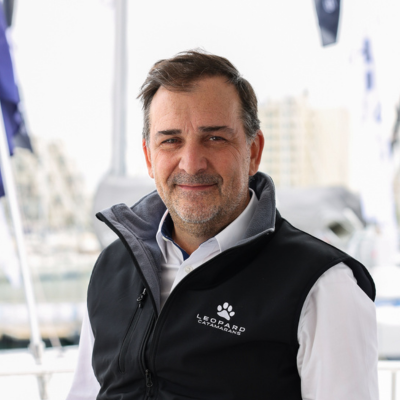
“When we developed the Leopard 52, the goal wasn’t to change what owners loved about the Leopard 50. It was to take a successful, trusted platform and make it better by adding space and comfort where it mattered most, while also carrying a more powerful, efficient sail plan that enhances performance without sacrificing the same confidence and predictability under sail.”
-Franck Bauguil, Senior Vice President of Sales and Product Development