Have you ever wondered what the process of buying a yacht actually looks like? There is no single “right way” to find the perfect boat. Every journey is different, and every buyer has different priorities. Some happy yacht owners purchase their boats sight unseen, while others spend years visiting boat shows, touring factories and comparing models before making a decision.
For Miranda and Owen, finding the right boat was nearly a decade-long journey. Along the way, they researched countless models, attended boat shows, toured boatyards and learned an important lesson: the perfect boat may not exist, but the right boat for your cruising plans does.
Here are five lessons they learned during their search and how they ultimately chose a Leopard 48.
1. Decide What Kind of Boat Fits Your Plans
“This journey started a long time ago. I have sailed most of my life and my daring, darling wife has been around and on boats for a large part of her life. In our early twenties, we spent a season as skipper and hostess working for Sunsail in Corsica managing twelve yachts on two-week flotilla trips,” Owen explains. “Fast forward to 2006 in Seattle — our sixth country and our fourteenth home and with a 13-year-old son — we were surrounded by the beautiful waters of the Puget Sound and so it was inevitable that the boating bug would bite again. A couple of years later a friend invited me to the Seattle Boat Show and that is when the search started.”
What originally began as a search for a trawler yacht eventually developed into a quest for a sailing catamaran. After researching fuel costs, Owen reconsidered their trawler plans and decided sailing was the way to go. “I was now convinced the thing to do was to purchase a capable yacht, outfit it correctly and then sail off into the sunset upon retirement.” One advantage of purchasing a new yacht is the opportunity to build and outfit it around your own cruising plans and preferences. But before Owen and Miranda could think about options and equipment, they had to decide what type of boat would best support the lifestyle they envisioned.
They became frequent boat show attendees, adding both the Annapolis Boat Show and Miami Boat Show to their annual plans. As they explored more boats, they noticed something: they were increasingly drawn to catamarans. Three things stood out — space, stability and, of course, the trampoline. “All the serious sailing I had ever done was on monohulls. Could a cat go around the world? To answer that question I started absorbing every blog and every forum that had to do with catamarans, big ones, small ones, French ones, South African ones, the list went on.”
At every boat show, they compared features, build quality and layouts. They listened to salespeople explain the advantages of different models and, perhaps most importantly, talked to sailors who were already out there cruising. That led them to their next lesson.
2. Do Your Research
As the search continued, Owen and Miranda came to an important realization: there may be no such thing as a perfect boat. “There is no such thing as a perfect boat. Every yacht is a compromise somewhere. It could be the helm station, it could be the galley, it could be the saloon, you name it there is something not quite perfect in every yacht we climbed aboard.” Instead of searching for a boat that checked every conceivable box, they began thinking about which features mattered most for the way they planned to cruise. “You really have to define your mission carefully and as part of that what you are personally comfortable with when it comes to safety on board.”
For prospective catamaran buyers, that is an important distinction. The right boat for coastal cruising may not be the same boat someone chooses for extended bluewater passages or full-time liveaboard life. Layout, performance, storage, ease of maintenance, sail handling and onboard comfort may carry different weight depending on how you plan to use the boat.
For Owen, the research continued. “The years ticked by. I continued my research diligently — I avidly read every blog of every catamaran cruising couple I could get my hands on. I downloaded and studied every spec of every catamaran that was vaguely within our range and I continued to drag my poor wife around more boat shows.” Eventually, however, researching every possibility became less useful than narrowing the field.
3. Narrow Down Your Options
Once you have a clearer picture of how you plan to use your yacht, establishing some firm parameters can make the buying process much easier. For Owen and Miranda, that meant setting limits on both size and budget. “In our case we realized we needed to set a length limit and a price limit in order to get really focused. We decided upon the 45 to 50 foot range as being optimal.” With those parameters established, they could compare boats based on the factors that mattered most to them.
They considered the accessibility of systems and maintenance areas, knowing they would need to perform routine tasks while cruising. They looked closely at the comfort and size of the cockpit and saloon. They also considered sail handling and whether the boat would be manageable for them underway.
Around this point in their search, a new and improved version of a boat Owen had previously considered was announced. He flew to Los Angeles for a sea trial and ultimately negotiated a refundable deposit. “The reason I wanted it to be refundable was because we were about to head home to South Africa for a family visit and also to visit three boat yards in South Africa.” That trip would change their plans once again.
4. Visit Boat Shows and Boatyards
Researching specifications and looking at photos can tell you a lot about a boat, but there is no substitute for stepping aboard — or seeing how one is built. Of the three factories Owen and Miranda visited in South Africa, the third was Robertson & Caine, builder of Leopard Catamarans, where they had the opportunity to take a closer look at the Leopard 48.
Several competitive brokers had raised concerns with Owen about the Leopard’s forward cockpit. But seeing the boat and its construction firsthand gave him the opportunity to investigate his questions for himself. Owen was particularly interested in the large forward saloon window. “I did not subscribe to those fears. However, I was concerned about the impressive flat front saloon window. It was great in that it let a lot of light into the boat; however, I worried about the integrity of that window in the event of a large wave smashing against it.”
Robertson & Caine allowed Owen to tour the factory and inspect yachts at different stages of construction. “When I saw the build quality and the strength of the structure housing the front saloon window I was completely satisfied that strength would not be an issue. I spent a happy few hours in the factory looking at all aspects of the build and came away a very satisfied boy!”
Seeing the Leopard 48 being built also helped the couple appreciate one of the features that would ultimately influence their decision: the forward cockpit. They decided to revoke their deposit on the other yacht. “The primary reason was the forward cockpit on the Leopard. We had really fallen in love with that space and that coupled with the very modern clean look of the Leopard affirmed that it was a better buy,” Owen explained.
5. Make the Decision
Eventually, every boat search reaches the same point: you have to make a decision. After visiting the Robertson & Caine factory and revoking their deposit on a competing yacht, Owen and Miranda appeared to have found their boat. But after nearly a decade of research, they wanted to be certain.
They headed to the 2016 Miami Boat Show for one last look at what the catamaran market had to offer. Another new option briefly caught their attention, and a persuasive sales pitch almost convinced them to change course again. But their hearts were still leaning toward Leopard. “After a couple of sleepless nights, we decided to go for it.”
From there, the process moved quickly. They selected their key options, sent the wire transfer and officially became “owners in waiting.” Owen and Miranda had chosen the Leopard 48. “With the big decision made we still went to the Annapolis show in October — but now the mission was ‘toys’ shopping — that is another whole saga.”
Their years of research hadn’t uncovered a universally perfect yacht. Instead, the process helped them understand exactly what their perfect boat needed to offer.
Finding the Right Catamaran for You
Owen and Miranda’s journey is a reminder that choosing a catamaran is as much about understanding your own priorities as it is about comparing boats.
Start by defining how you intend to use your yacht. Determine a realistic size and budget. Think about which features are essential and which compromises you are willing to make. Visit boat shows, step aboard different models, talk to experienced owners and, when possible, see how the boats you are considering are built.
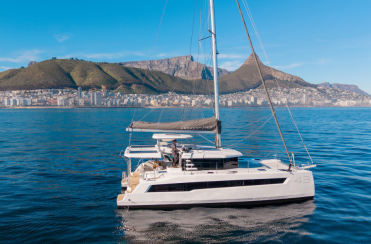
For Owen and Miranda, that process ultimately led to Sarabi, their Leopard 48, built by Robertson & Caine in Cape Town, South Africa.
The search may take months or even years, but the research you do along the way can help you make a more confident decision when you finally find the boat that fits your plans.
Ready to begin your own search? Explore Leopard Catamarans and use our Build Your Boat tool to discover the models, layouts and options that best fit your cruising plans.