The catamaran you buy today will be the catamaran you own for the next decade or more. Just think about what that actually means for a second.
The solar system you choose today will still be running your refrigerator long after the next model has launched. The way your hull was built will shape how your boat sails and holds its value for as long as you own it. The layout you choose will shape thousands of mornings on the water, and the energy architecture beneath the floorboards will decide whether you spend your evenings at anchor in silence or listening to a generator humming through dinner.
And with the catamaran industry having a moment in design innovation, from hybrid propulsion, lithium battery banks, foiling daggerboards, single-shot infusion, AI-assisted route planning, smart-home integration, modular layouts, panoramic glass and regenerative everything, it is easy to get lost in the hype of flashy new gadgets.
While some of these trends are genuine, durable advances that change how a catamaran sails, lives, and lasts, others are simply spec sheet decoration, dressed up to sound revolutionary at a boat show and quietly forgotten by the time the next model launches. The hard part for any prospective owner isn’t keeping up with the trends. It’s separating the ones that actually improve life on the water from the ones that just look good in a brochure.
So which catamaran design and technology trends are real, and which are noise? What’s genuinely changing the way modern catamarans are built, rigged, powered, and lived on? And how do you tell, when you’re standing on a brand new boat, whether the innovations you’re looking at will still feel relevant five years from now?
This guide will walk you through the design and technology trends actually reshaping modern cruising catamarans, which of them matter most for real-world owners, and how to tell genuine engineering from marketing decoration when the time comes to choose.
Energy Smart Cruising: The New Standard for Modern Catamarans
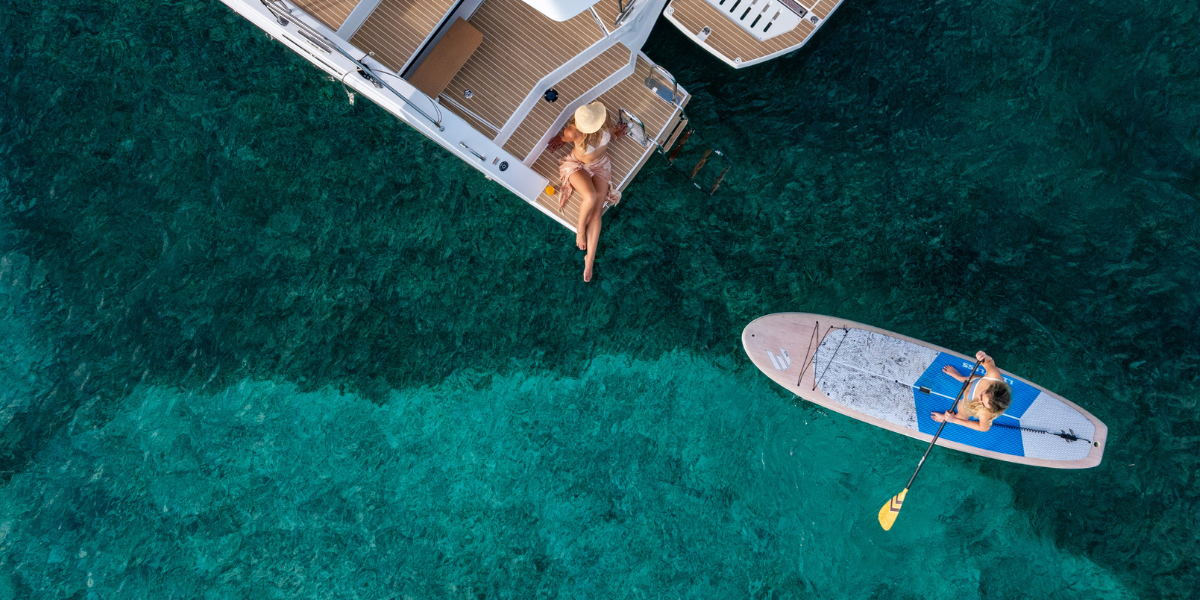
If you had to pick the single biggest shift in catamaran design over the past decade, it would be the way modern catamarans generate, store, and manage energy. This trend towards complete energy autonomy started as a niche concern for hardcore offshore cruisers, and has become the single most important design priority for every new catamaran being built today.
And the reason for this comes down to what modern owners actually want from their boats. They want to spend less time tethered to marinas and more time anchored in places that don’t have a fuel dock. They want to run the air conditioning at anchor without listening to a generator all night. They want to charge their devices, run their watermakers, keep their refrigerators cold, and power all of their electronics without a second thought.
That kind of independence used to be reserved for owners willing to retrofit a complex aftermarket setup. Today, it’s increasingly engineered into the boat from day one. And this is one technological advance that isn’t going anywhere. Energy independence has crossed the line from optional upgrade to fundamental expectation, and the catamarans built around this principle from the start will be the ones that still feel modern a decade from now.
Solar Ready Design: Built In, Not Bolted On
Solar power on catamarans is nothing new. But what has changed is how it’s integrated. The previous generation of cruising catamarans treated solar as an aftermarket addition. You bought the boat, then bolted on an arch with a few panels, ran the wiring through whatever holes you could find, and hoped for the best. The result was visually awkward, structurally compromised, and electrically inefficient.
Modern catamaran design has flipped this entirely. The trend now is factory-integrated solar, where panels are flush-mounted into the bimini or coachroof, wired directly into the boat’s electrical architecture during build, and matched to the battery bank from day one. The aesthetic is cleaner, the structural loads are accounted for, the wiring is hidden and protected, and the energy yield is dramatically higher because the system is engineered as a whole rather than assembled from parts.
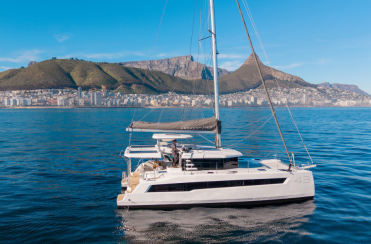
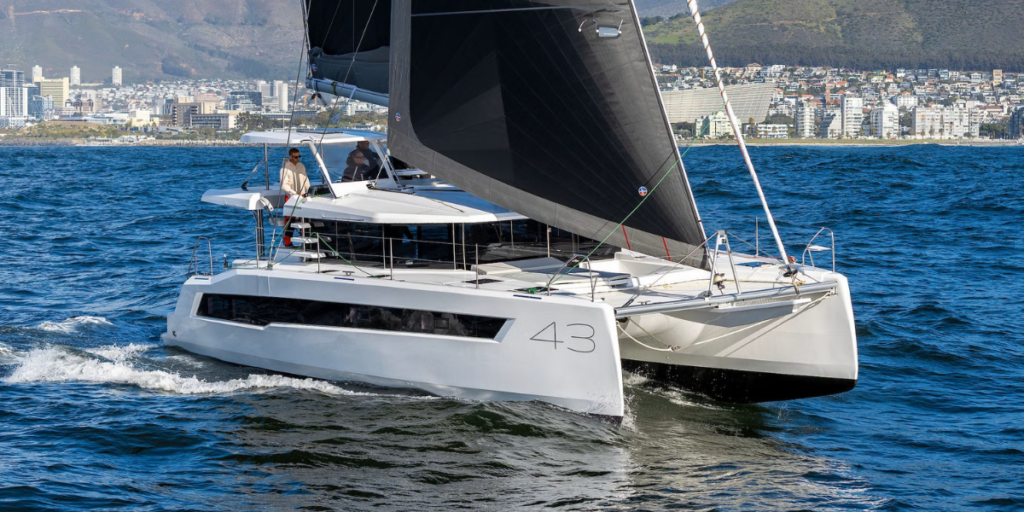
The new Leopard 43 is one of the clearest examples of this evolution in action. It carries 1,365 watts of integrated solar on the bimini hardtop, replacing the stainless-steel panel-mounting structures used on its predecessor. That’s a meaningful daily energy contribution for a boat of this size, and the integrated design cuts weight up high, removes the visual clutter of an aftermarket arch, and strengthens the structural lines of the boat. And the Leopard 52 takes this even further with up to 1,600 watts of factory-integrated solar.
So, when you’re standing on a catamaran and trying to figure out where it lands on this evolution, ask one simple question: was the solar designed in, or was it added on? The two might look similar at the dock. But they won’t feel anything alike five years into ownership.
Lithium Batteries and Energy Management: The End of the Compromise
Lithium battery banks have become one of the most transformative trends in the catamaran industry. And the reason is simple. Lithium changes the math of off-grid living in a way the old AGM batteries never could.
A lithium bank can be safely discharged down to around 20%, which means you actually get to use about 80% of what’s in it. AGM batteries top out at around 50% before you start damaging them. That’s a huge gain in working energy from the same rated bank size, and you don’t pay for it in weight or volume. Lithium also charges faster, accepts power aggressively from solar and alternators right up to full, and lasts a lot longer over its service life. On a cruising catamaran, where every pound affects how the boat sails, the weight advantage alone is worth the conversation.
But the real evolution isn’t just in the batteries themselves. It’s in how owners actually interact with them day to day. Modern catamarans now integrate battery management systems, digital switching, and energy monitoring straight into the helm display, so you can see in real time exactly what’s coming in from solar, what’s being used, what’s in the bank, and what’s left in reserve. The intimidation factor that used to define catamaran energy management is gone. What’s replaced it is something a lot more like the dashboard of a modern car. If you can drive a Tesla, you can run a modern lithium catamaran.
Reduced Generator Reliance and the Rise of Hybrid Propulsion
Here’s where the conversation gets genuinely interesting. The older generation of cruising catamarans treated the generator as a non-negotiable workhorse. You ran it daily, sometimes for hours, to keep up with the energy demands of refrigeration, air conditioning, and water-making. The generator’s noise, vibration, and fuel consumption were simply the cost of cruising independently.
The trend in modern catamaran design is to push that reliance as far down as possible. With factory-integrated solar arrays of over 1,000 watts and lithium banks designed for high capacity and fast charge acceptance, generator runtime on a well-equipped modern catamaran can drop dramatically. For owners cruising in sunny latitudes, days at anchor without ever starting the generator are now genuinely achievable.
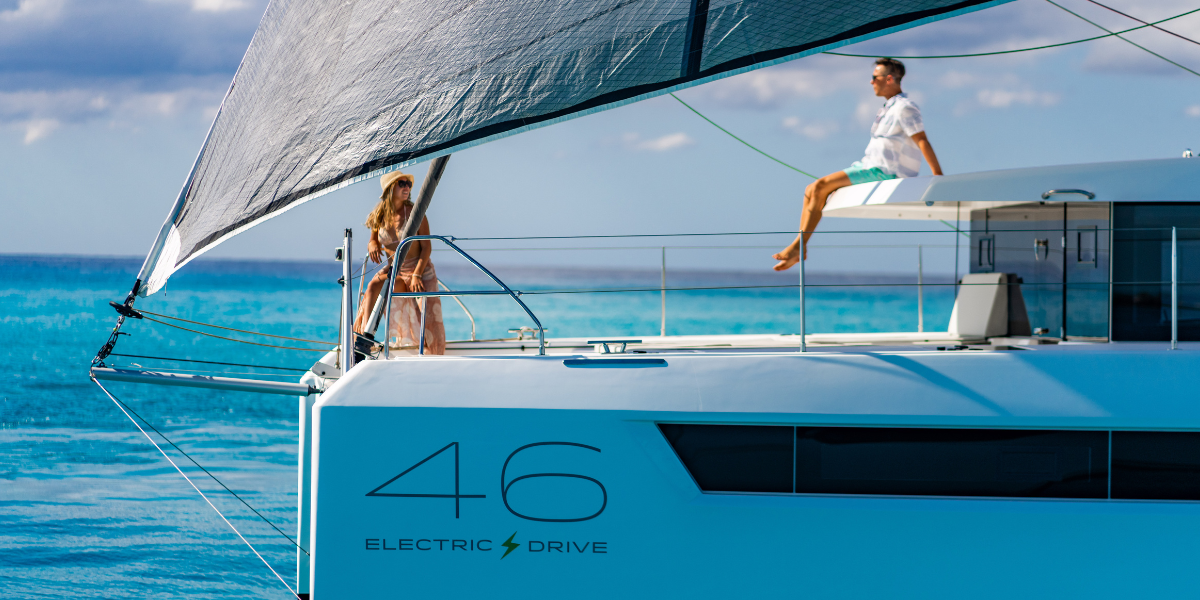
Hybrid electric propulsion is the most ambitious expression of this trend, and it’s starting to filter into the production catamaran market in a serious way. The Leopard 46 hybrid system, which won Cruising World’s 2025 Boat of the Year, combines two 25kW electric pod saildrives with two 27kWh lithium battery banks, a 24kW range-extending generator, and 1,600 watts of factory-integrated solar. Hydro-regeneration kicks in at sailing speeds as low as 4 knots, but real-world output of around 1.5 to 1.8kW per hour per hull only happens above 8 knots of boat speed. In full electric mode, the boat motors at 6 knots for around 4 hours; in hybrid mode, range extends to 920 nautical miles at the same speed. The Leopard 52 offers a similar architecture, scaled to the larger platform. They’re real, they’re charter-fleet proven, and they represent the most serious step forward in cruising catamaran propulsion in a generation.
That said, hybrid isn’t for everyone. The system adds cost and complexity, and the regen penalty under sail (a fixed-prop drag of around one knot compared to folding props) is a real trade-off. For most cruisers, a well-designed traditional diesel setup paired with a strong solar array and lithium bank still represents the smarter, simpler choice. The trend that matters most isn’t hybrid propulsion specifically. It’s the broader shift toward energy independence that hybrid systems represent. And which direction you take depends on how you actually plan to cruise.
Construction Innovation: Stronger, Lighter, More Consistent
Energy systems are the visible trend. Construction innovation is the invisible one. And in many ways, it’s the more important shift, because how a catamaran is built determines how it sails, how it lasts, and how safely it handles the conditions it will eventually meet offshore.
The catamaran construction trend that has quietly redefined the industry over the past several years is the move toward single-shot vacuum infusion. Understanding what this is, and why it matters, is one of the most useful things any prospective buyer can learn.
Advanced Resin Infusion: One Shot, Everything Bonded
Traditional fiberglass catamarans were built using hand-layup, where workers manually applied layers of fiberglass cloth and resin in stages. The process worked, but it produced inconsistent results. Resin pooled in some areas and ran short in others. Bond quality varied between layers and excess resin added weight without adding strength.
Vacuum infusion changed this. By laying out the dry fibers and core materials first, then drawing resin through them under vacuum pressure, the process produces a stronger, lighter, and far more consistent laminate. There’s no excess resin, no air voids, and no human variability in the bond quality. The result is a hull that’s stiffer, more impact-resistant, and lighter for its strength.
Single-shot infusion, the next evolution of this technique, takes it even further. Instead of building the hull in multiple sections that get joined together later, the entire hull is infused as one continuous piece in a single, uninterrupted resin pull. Every layer of the structure, the cloth, the core, and the outer skin, bonds together at the same moment under the same vacuum pressure. The result is a hull with no internal join lines, no secondary bonding zones to fail, and a far more consistent laminate from bow to stern.
Cruising World’s coverage of Leopard’s hull infusion process and Sail World’s reporting on Leopard advancing single-shot infusion both highlight this as one of the most significant production-side advances in the industry today. And the engineering evolution of the Leopard 52 puts the technique into practice across Leopard’s flagship sailing model. Compared to the Leopard 50, which used multi-section molds, the 52 is built around a single-piece hull mold, which means significantly fewer seams and bonded joints throughout the structure. That translates into better load distribution under sail, lower risk of delamination over decades of cruising, and a stronger, stiffer overall platform that holds its integrity for the long term.
Stronger, Lighter Hull Structures: Why Both Matter
The other big trend in modern catamaran construction is the use of advanced core materials. Lightweight closed-cell foam cores, paired with structural reinforcements made from carbon fiber in critical load-bearing areas, allow modern catamarans to achieve the strength of much heavier boats without the added weight.
Why does this matter? Because weight on a catamaran is the single biggest factor that affects performance, fuel efficiency, payload capacity, and motion at sea. A lighter, stiffer hull sails faster, carries provisions better, burns less fuel under power, and moves more predictably through waves. A heavier, less stiff hull does the opposite, regardless of how impressive the rest of the boat is.
Modern Leopard models are a clear expression of this philosophy in action. Vinylester resin chemistry, foam-cored composite hulls, and carbon-infused ring frames in the most heavily loaded areas of the structure all reflect the same goal: maximum stiffness at minimum weight. It’s not glamorous. It doesn’t show up on a boat show stand. But it’s one of the biggest things shaping how modern catamarans actually perform once they’re loaded for an extended cruise and pointed at open water.
What Buyers Should Understand About Build Methods
Here’s the practical takeaway for anyone evaluating a catamaran today. Don’t just ask what features the boat has. Ask how it’s built, and specifically focus on:
- Is the hull vacuum-infused or hand-laid? Vacuum infusion is now the production standard for any serious cruising catamaran. Anything less should give you pause.
- Is the construction single-shot or multi-section? Single-shot infusion is the newest evolution and the strongest indicator of a modern, well-engineered catamaran.
- What core materials are used, and where? Foam cores in the hull and deck, with carbon-fiber reinforcement in high-load areas like ring frames and bulkheads, signal a builder thinking seriously about strength-to-weight performance.
- Has the boat been certified to international safety standards? Look for NMMA/ABYC certification (the American standard) and CE certification (the European standard). Builders certified to both are rare, and the dual credential is a serious signal of safety intent. Leopard Catamarans is currently the only catamaran brand in the world to hold both certifications simultaneously, which means every Leopard is engineered to meet the strictest safety standards on either side of the Atlantic, not just the ones in the market it’s being sold into.
These aren’t questions that require a degree in marine engineering to ask. But the answers will tell you more about whether the catamaran in front of you is actually built for what it claims it can do, and whether it will still be relevant a decade from now. Because unlike solar arrays, sails, and electronics, which can be upgraded over the years, the hull is the one thing on the boat that you’re committing to for the entire length of your ownership.
Layout Evolution and Visibility: The Indoor-Outdoor Shift
If you walked onto a cruising catamaran from a decade ago and walked onto one launched today, the first thing you’d notice isn’t the hull or the rig. It’s the inside.
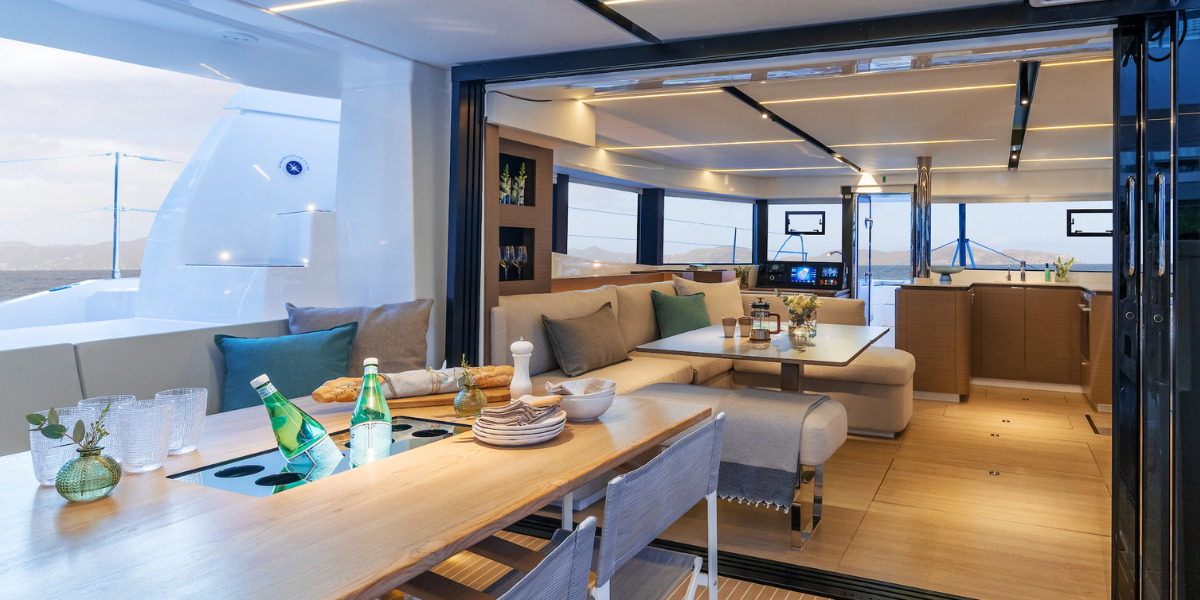
Modern catamaran layouts have evolved more visibly than any other part of catamaran design, and it all comes down to one realization that builders took a while to figure out. The best moments on a boat don’t actually happen below deck or above deck. They happen in the space between them. And every layout choice on a modern catamaran is now being designed to expand that space and the indoor-outdoor flow it creates.
Panoramic Saloons and Sightlines: Why the Glass Matters
It all starts with what’s around you when you’re inside. Modern catamaran saloons increasingly feature wraparound windows, oversized fixed glass panels, and minimal structural elements obstructing the view. The reason isn’t aesthetic. It’s functional.
A saloon with poor sightlines feels enclosed, even when it’s actually spacious. A saloon with full panoramic visibility feels open, connected to the water, and dramatically larger than its actual footprint. Natural light floods the interior throughout the day, reducing the strain of long passages and making everyday tasks like cooking, navigation, and watch-keeping easier and more pleasant.
This is something Leopard has built into every current model in its range. Wraparound saloon windows, oversized panels, and minimal interior structure between you and the view are no longer features reserved for one model. They are the standard across the lineup. Whether you’re standing in the saloon of a Leopard 43, 46, or 52, you’re looking out at almost 360 degrees of horizon, with as little hull structure breaking the view as the engineers could possibly get away with.
Indoor-Outdoor Living Spaces: The Modern Catamaran’s Best Trick
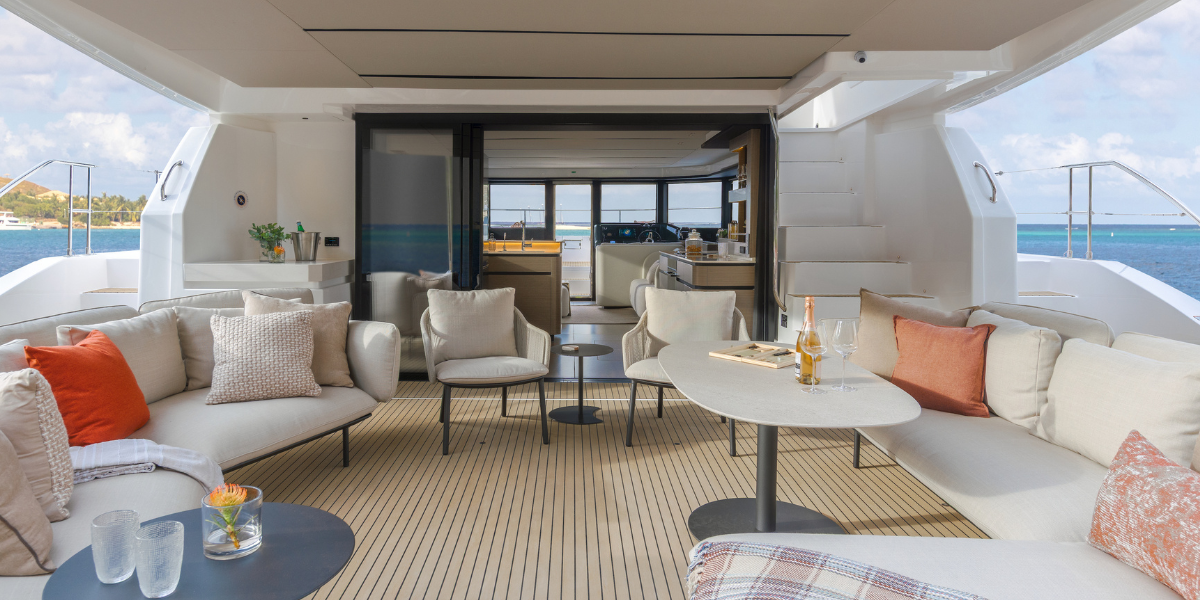
On modern catamarans, the saloon, galley, and aft cockpit are no longer three separate rooms. They’re one connected zone, with stackable sliding doors, watertight forward access, and an open flow that lets the entire main deck function as a single social space when conditions allow, and a fully sealed, climate-controlled interior when they don’t.
It’s the same shift that’s already happened to modern homes. Open-plan living rooms, kitchens that flow into entertaining spaces, and walls of glass that connect the interior to the garden have become the standard for residential design over the past two decades. Catamaran design is following the same path, and any layout that still treats those zones as separate rooms will quickly start to feel dated for the same reason a 1990s suburban floor plan does today.
What really makes this work on a catamaran is the connection between the saloon and the aft cockpit. Stackable sliding doors that retract fully behind the helm station, a level transition with no step-down between the two zones, and a galley oriented to keep the cook in the conversation rather than tucked away are the design choices that genuinely dissolve the line between inside and outside living.
Leopard takes the concept a step further with its signature forward cockpit door, an idea the brand pioneered back in 2010 on the Leopard 44 and now refined across the entire range. The forward door creates a direct bow-to-stern airflow path that transforms ventilation below deck, makes foredeck access genuinely safe in any conditions, and adds an outdoor lounge zone forward of the saloon that most catamarans simply don’t have. It’s not what makes the indoor-outdoor flow work on its own. But it’s what extends it from one open zone into something closer to a fully connected, end-to-end living space.
For owners, all of this delivers something more valuable than just space. It delivers flexibility. The same boat can host a dinner party for ten, work for a couple sailing alone, open up as an air-cooled lounge in the tropics, or seal up tight for a stormy passage, with no structural compromise. That’s the kind of versatility that genuinely changes how owners use their catamarans, year after year.
Safety and Comfort Benefits That Compound Over Time
It would be easy to dismiss panoramic glass and integrated indoor-outdoor living as cosmetic trends. They’re not. Both deliver real, practical benefits that build up over years of ownership, in ways most buyers don’t fully appreciate until they’ve lived with them.
Visibility from inside the saloon makes watch-keeping safer because the person on watch can scan the traffic, the weather, and the shoreline from a protected position rather than only from the helm. Natural light reduces fatigue and keeps crew morale up on long passages. Cross-ventilation keeps the interior cool in the tropics without leaning entirely on air conditioning, which means more time at anchor and less generator runtime. And a layout that flows naturally between inside and outside means the crew can move between cooking, helm watches, social time, and sleep without getting in each other’s way or losing situational awareness.
None of this jumps out at you on a boat show walkthrough. But it’s exactly what defines whether you actually enjoy living aboard once the novelty wears off.
Performance Refinements: Faster Without Sacrificing Comfort
The performance side of catamaran design has evolved more quietly than the energy or layout sides, but the changes are no less real. The trend that defines this category is refinement rather than reinvention.
Modern cruising catamarans aren’t trying to become race boats. They’re trying to sail meaningfully better while maintaining the comfort, payload capacity, and stability that made cruising catamarans appealing in the first place.
Refined Sail Plans: More Power, Easier to Handle
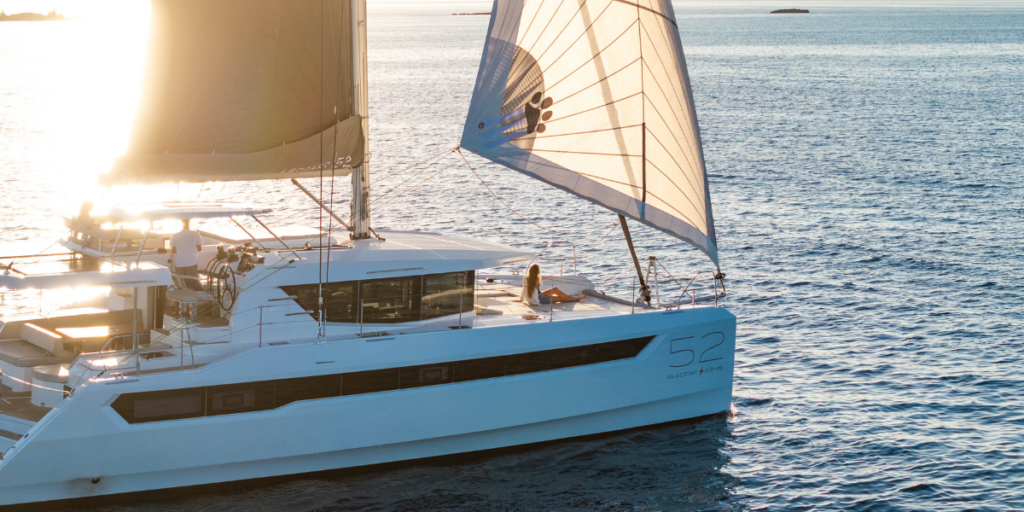
The most visible performance trend in modern catamaran design is the move toward larger, taller rigs with more sophisticated sail plans. The Leopard 52, for example, carries 17% more upwind sail area than its Leopard 50 predecessor, with a taller mast and longer boom designed to deliver meaningfully better light-air performance. Square-top mainsails, overlapping genoas, and Code 0 sails are increasingly available as factory options across the cruising catamaran industry.
But what makes this trend genuinely useful, rather than just a performance number on a brochure, is that the same designs are also being engineered for easier handling. Electric winches at the helm, all sail control lines led aft, lowered booms for safer stack-pack access, and ergonomically positioned controls mean the modern catamaran owner can take advantage of a more powerful sail plan without needing more crew or more physical strength to manage it.
As BoatNews observed of the Leopard 52, the increased sail area “improves upwind performance and reduces the need for engine power,” which is the trend’s real value. More performance under sail means less time motoring, less fuel burned, and less generator dependence.
Hull Efficiency: Wave-Piercing and Stepped Designs
The other big performance shift is happening below the waterline, in the actual shape of modern catamaran hulls. Wave-piercing bows, stepped hull designs, and finer entry forms are becoming the production standard, replacing the fuller hull shapes of earlier generations. And the difference shows up in just about every aspect of how a boat sails.
What’s driving the change is a combination of better understanding and better tools. CFD modelling, or computational fluid dynamics analysis, is now a standard part of modern catamaran development across the industry. The hull shapes you see on the water today are the result of a level of digital optimization that simply wasn’t possible a decade ago. Builders aren’t guessing anymore. They’re refining.
Across the current Leopard sailing range, that refinement plays out in different but consistent ways. Wave-piercing hulls and reverse bows on newer models are designed to slice through chop and reduce pitching in a seaway. Stepped hull designs across the range allow narrower waterlines for sailing performance, while keeping flared topsides above the waterline for the interior volume cruising owners actually need. The benefits are twofold: the boats sail faster and more efficiently, and they move through waves more smoothly and predictably.
The performance gains from all this aren’t dramatic on paper. But they show up everywhere it actually matters, in fuel efficiency, in motion comfort, in upwind capability, and in how the boat feels during a long passage.
Balancing Performance and Comfort
The biggest mistake in evaluating modern catamaran performance is assuming that “performance” and “comfort” sit at opposite ends of a spectrum. They don’t, at least not anymore. The trend that defines modern catamaran design is the realization that these two concepts reinforce each other.
A boat that sails efficiently uses less fuel and runs its engines less. A hull that moves predictably through waves keeps the crew rested and capable. A rig that’s easier to handle reduces fatigue and lets owners sail in conditions they’d otherwise motor through. Performance refinements, done right, don’t compromise comfort. They enable it.
The catamarans that get this balance wrong tend to fall into two camps. Either they sacrifice payload, livability, and offshore comfort in pursuit of racing-style performance numbers, ending up as boats that are exhausting to actually live on. Or they ignore performance entirely in favor of maximum interior volume, ending up as big boxy boats that motor everywhere and burn through fuel just to maintain a reasonable schedule. The modern Leopard range sits in the middle of this spectrum: refined performance that makes cruising better without compromising the things that make a cruising catamaran worth owning in the first place.
What These Trends Mean for Buyers Right Now
Knowing which trends are real is one thing. Putting that knowledge to work the moment you have to make a decision on a real boat, with a real price tag, in a real shipyard or brokerage, is another.
So how do you take everything we’ve covered so far and turn it into a framework that actually guides your next purchase? It comes down to one simple question worth carrying with you to every boat show and every sea trial: will this trend still matter in ten years, when the novelty has worn off and the boat is being asked to do what you bought it for?
Some trends pass that ten-year test no matter what kind of cruiser you are. Others only pass it for certain owners, depending on how you actually plan to use the boat. Both are worth understanding before you buy.
Which Trends Add Long-Term Value
Some trends are meaningful regardless of how you plan to cruise. They add value to ownership in ways that compound over years, and they tend to maintain that value well into the resale market.
Factory-integrated solar and lithium banks belong at the top of this list. The reduction in generator runtime, the gain in off-grid independence, and the operational simplicity these systems deliver offer universal benefits. They don’t depend on cruising style or destination.
Single-shot vacuum infusion construction and dual NMMA/ABYC and CE certification. Build quality and structural integrity are permanent features of the boat. You can’t add them later, and they affect every aspect of how the catamaran sails, lasts, and performs across decades of ownership.
Panoramic visibility and integrated indoor-outdoor layouts. They change the daily experience of being on the boat in ways that are immediately apparent and never wear off. Wraparound saloon glass and seamless cockpit-to-saloon transitions are now setting a standard that older designs simply can’t match.
Which Trends Depend on Cruising Style
On the other hand, some trends are only genuinely valuable depending on how you plan to cruise and use your boat.
Hybrid electric propulsion is a clear example. For owners who want to disappear for days at a time and value reduced generator runtime, hybrid systems deliver real benefits. But for owners who cruise on weekends and spend most nights in marinas, the regen drag and added cost may not justify the upgrade. Both decisions are valid; they just lead to different boats.
Maximum solar capacity (1,600+ watts). If you’re a full-time liveaboard or cruising in the tropics, the bigger array genuinely changes what’s possible. If you’re a weekend cruiser plugged into shore power most nights, the smaller standard array does the job just fine.
Performance sail upgrades like square-top mainsails and Code 0 sails are another one of those it-depends-on-you choices. They genuinely transform light-air and downwind sailing for owners who spend their time chasing the wind. But for owners who tend to fire up the engines whenever the breeze drops, they’re mostly there to look good in photos.
Questions to Ask When Touring or Sea Trialing
Whether you’re at a boat show, walking through a brokerage listing, or sea trialing a model you’re seriously considering, the right questions are the most useful tool you can carry. They cut through the flashy gadgets and marketing buzz words and give you a real basis for comparing one model against another.
Here are the seven questions worth committing to memory before you walk onto your next catamaran.
- How is the hull constructed? Vacuum infusion is the modern production standard. Single-shot infusion is the newest and strongest evolution of it.
- Is the solar factory-integrated, and what’s the total peak wattage? Factory-integrated arrays outperform bolt-on retrofits in every meaningful way. Look for 800 watts as a practical minimum, 1,200 watts and above for genuine off-grid independence.
- What battery chemistry comes standard? Lithium should now be the default on any serious cruising catamaran, not an upgrade. Ask for the usable capacity at recommended discharge depth, not just the nominal rating.
- How are sail control lines led? Every line should run aft to the helm. A single person should be able to raise, trim, reef, and furl every sail without leaving the cockpit. If the answer involves going forward to the mast, that’s a design generation behind where the industry is now.
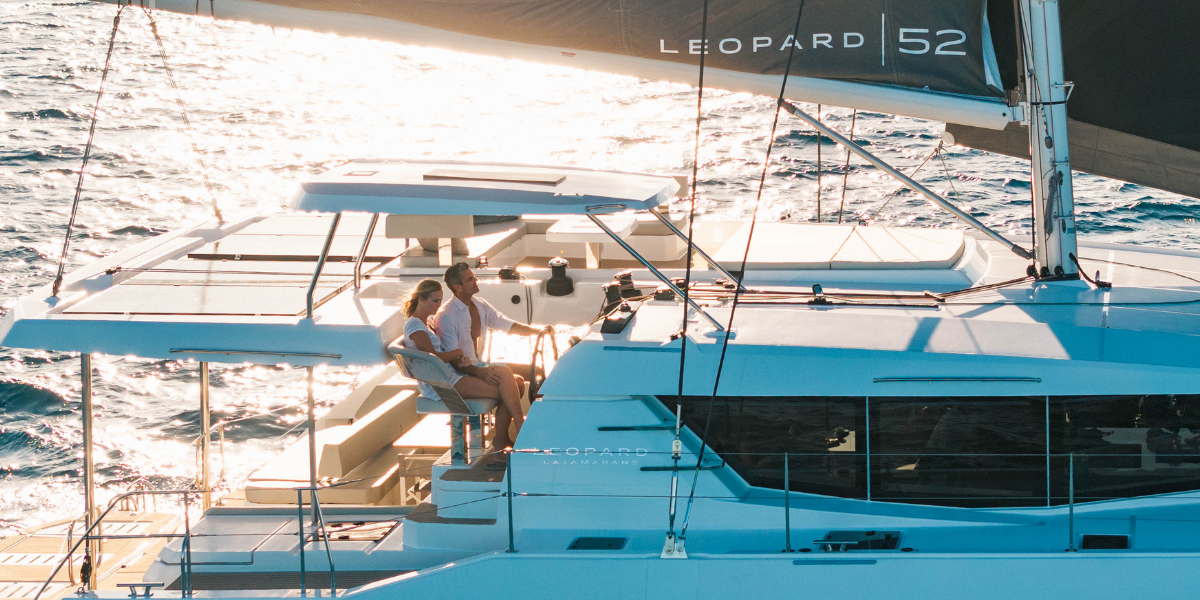
- What’s the helm visibility like, and is it protected? Genuine 360-degree sightlines and a hardtop that shields you from sun, spray, and rain are no longer optional on a serious modern catamaran. Sit in the helm seat and check the sightlines yourself.
- How does the layout flow between saloon, galley, and cockpit? The best modern catamarans treat these as one connected indoor-outdoor space. Sliding doors, a forward cockpit access point, and a galley oriented to keep the cook part of the conversation are all signs of a layout designed around how people actually live aboard.
- What certifications does the boat hold? Look for NMMA/ABYC (the American standard) and CE (the European standard). Boats certified to both are rare. They reflect a builder genuinely committed to safety on any ocean.
Frequently Asked Questions About Modern Catamaran Design Trends
What are the most important catamaran design trends to look for in 2026?
The most important trends are factory-integrated solar arrays paired with lithium battery banks, single-shot vacuum-infused hull construction, panoramic saloon glass with integrated indoor-outdoor layouts, and refined sail plans designed for short-handed handling. These trends represent durable improvements that affect performance, comfort, longevity, and resale value across years of ownership, regardless of cruising style.
Is hybrid propulsion worth it on a cruising catamaran?
It depends on how you cruise. Hybrid propulsion delivers real benefits for owners who anchor frequently, want silent maneuvering, and value reduced generator runtime. The system adds cost and some complexity, and the fixed propellers required for hydro-regeneration create a small drag penalty under sail. For most owners, a well-designed traditional diesel setup paired with a strong solar array and lithium bank delivers most of the benefits at lower cost and lower complexity. Owners who specifically want silent electric operation should consider hybrid; those who don’t are well served by the traditional setup.
What is single-shot hull infusion and why does it matter?
Single-shot infusion is a hull construction method where the entire hull is vacuum-infused with resin in one continuous process, rather than being built in multiple sections that are later joined together. The result is a stronger, lighter, and more uniform hull with no joint lines or seams that could become weak points over time. It represents the current production standard for serious cruising catamarans, and Leopard has implemented this process across the new Leopard 46 and Leopard 52.
How much solar capacity does a modern cruising catamaran actually need?
For full off-grid independence, including running refrigeration, navigation electronics, lighting, watermaker, and basic appliances, 800 watts is a practical minimum. For owners running air conditioning at anchor or working remotely with high power demands, 1,200 watts and above is recommended. Newer Leopard models reflect this trend with significantly increased standard solar capacity: the Leopard 43 carries 1,365 watts as standard, and the Leopard 52 supports up to 1,600 watts of factory-integrated solar.
How can I tell if a catamaran is built to current design standards when shopping the brokerage market?
Look for vacuum-infused construction (now an industry standard for serious bluewater cruisers), dual NMMA/ABYC and CE certification (rare and a strong indicator of build quality), modern sail controls led aft to the helm, and energy systems that have been upgraded or were originally specified with lithium and significant solar capacity. A surveyor familiar with catamarans is an essential investment for any brokerage purchase, both for assessing the current condition and for identifying where you might need to make upgrades.
Choosing a Catamaran Built for the Future
The catamaran industry will keep producing trends. Some will become permanent features of how cruising catamarans are built. Others will quietly disappear once the marketing cycle moves on. The challenge for any buyer isn’t keeping up with every announcement. It’s recognizing which innovations actually improve life on the water and which are noise.
The trends that matter share a common pattern. They’re built into the architecture of the boat, not bolted on. They solve problems that owners actually face, and they make the boat better to live on, easier to handle, more efficient to operate, and more durable over years of ownership.
Leopard Catamarans have spent nearly three decades refining what cruising catamaran design means in practice, and the current range, from the Leopard 43 sailing cat through to the flagship Leopard 52, reflects this accumulated owner feedback. From factory-integrated solar, single-shot infused hulls, panoramic glass, hybrid propulsion options, and refined sail plans: these aren’t trends Leopard is following. They’re trends Leopard is helping to define.
So where do you go from here? Start by exploring the full Leopard sailing catamaran range and comparing how each model expresses these design trends in practice. Dig into the Leopard news and engineering articles to see how the brand thinks about design evolution from the inside. And when you’re ready to evaluate a specific model in person, connect with a Leopard specialist who can walk you through the engineering choices behind each boat and match them to the way you actually plan to cruise.