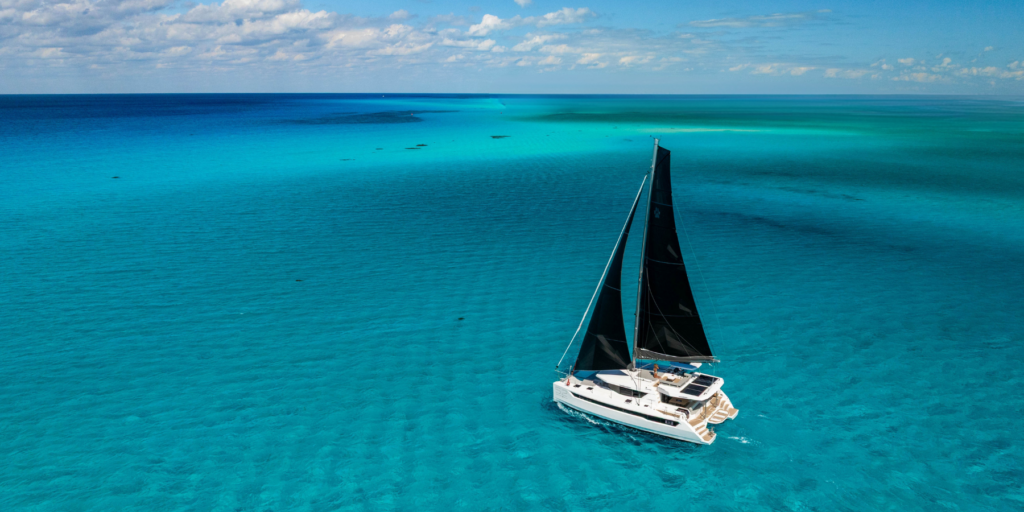
There’s a truth about “bluewater yachts” that often gets glossed over: not every modern cruising catamaran is truly built for long‑range ocean passages.
Long‑range cruising isn’t just about owning a bigger boat or adding extra fuel tanks. It means leaving the safety net of marinas and short coastal hops behind. It’s standing a night watch at 3 a.m. with a squall line on the radar, knowing the next safe harbor is days away. It’s running your boat like a small off‑grid island, with your power, water, systems, and spares all onboard because there’s no marine store around the corner.
That’s why the first and most important decision is not “Which yacht is best?” but “How am I really going to cruise?” There’s a big difference between mostly coastal sailing in settled conditions and crossing oceans or spending seasons far from support. The right long‑range cruising catamaran is the one matched to your real cruising profile—not just the one that looks impressive at the dock.
What Does “Long Range Cruising” Really Mean?
When we talk about “long‑range cruising” on a catamaran, we mean the ability to travel for weeks at a time with confidence—often far from marinas, chandleries, and easy escape routes. It’s less about a specific mileage number and more about whether your yacht can carry the loads, handle real offshore weather, and keep your crew safe and functional the whole way.
For some owners, long‑range cruising means bluewater passages between continents. For others, it looks like slow exploration of remote islands, or months spent living aboard and moving with the seasons. In every case, the common thread is autonomy: your yacht has to function as a safe, self‑reliant platform away from easy shore support.
Coastal Cruising vs Offshore Passages
Coastal cruising is what most sailors picture when they think of owning a boat: moving from anchorage to anchorage, staying within sight of land, and knowing a marina is never far if the weather turns. It’s relaxed, flexible, and most production catamarans handle it well.
Offshore passages are a different discipline. Instead of short hops between ports, you’re crossing open water for days or weeks at a time with no safe harbor in sight. Conditions can build overnight, and a squall with 40–45 knots on the beam at 2 a.m. will test both boat and crew in ways that coastal sailing rarely does.
What a True Offshore Cruising Yacht Must Deliver
Unlike relaxed coastal cruising, true offshore sailing demands real self‑sufficiency. You need enough fuel, water, and provisions to outlast your original plan, plus the ability to troubleshoot and repair critical systems without a marina nearby. Add in night watches, crew rotations, and fatigue, and it’s clear that serious offshore sailing requires a boat that’s prepared for extended passages—not just one that looks the part.
In practice, a long‑range cruising catamaran has to deliver three things without compromise:
- Range and storage for fuel, water, provisions, and spares.
- Redundancy and reliability in every critical system.
- Seakeeping and motion that keep the crew functional, not miserable.
Leopard Catamarans are designed around these offshore realities. Every model is sea‑trialed off Cape Town, South Africa—one of the world’s most demanding test environments—before reaching an owner. Those trials validate core design choices: vacuum‑infused hulls for strength without excess weight; generous bridgedeck clearance for quieter, less punishing passages; all sail controls led aft for safe shorthanded sailing; a watertight forward cockpit door that dramatically improves natural ventilation through the saloon at anchor; factory‑integrated solar with optional hybrid propulsion on the Leopard 46 and Leopard 52 for extended self‑sufficient cruising; and dual NMMA/ABYC and CE certification across the Leopard range, reflecting a serious commitment to offshore safety and performance.
Comfort Thresholds at Sea: Why It Defines Your Bluewater Cruising Experience
Unlike coastal cruising, offshore comfort isn’t about finishes or amenities—it’s about how a boat behaves in motion and how well it supports daily life at sea. Hull shape, bridgedeck clearance, helm ergonomics, and load distribution directly affect how you sleep, cook, stand watch, and function when conditions are sustained rather than occasional.
When you’re sailing for days in consistent trade‑wind conditions—15 to 25 knots with open‑ocean swell—small design differences become magnified. Boats that move predictably allow crews to settle into a routine. Boats that slam, pitch, or demand constant correction quickly drain energy and focus.
Offshore comfort is not a luxury feature. It’s a performance threshold that directly affects endurance, decision‑making, and safety over long passages.
How Leopard Catamarans Support Offshore Comfort
The boats that exhaust crews offshore are rarely the ones that fail structurally—they’re the ones that never quite let anyone rest. Leopard’s approach to offshore comfort is grounded in real passage‑making experience, refined over three decades and more than 3,100 yachts delivered worldwide.
From hull geometry to helm layout to interior orientation, Leopard designs are shaped by how boats are actually lived on at sea, not how they appear at the dock.
Wide Beam, Hull Separation, and Motion Control
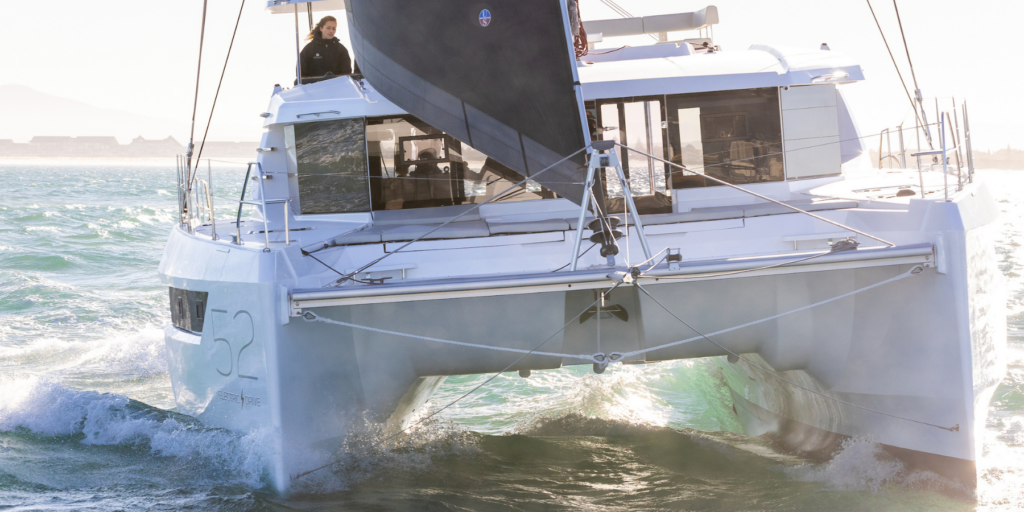
Leopard’s characteristically wide beam creates a stable offshore platform that resists the rolling and abrupt motion that erodes sleep and morale on long passages. On the Leopard 52, for example, a beam of 26 feet 9 inches places the hulls farther apart than many competitors in its class, fundamentally altering the boat’s motion in a seaway.
Wider hull separation slows roll response and reduces hobby‑horsing, while Leopard’s stepped hull design balances performance with volume and helps minimize bridgedeck slamming in active conditions. The result is a gentler, more predictable motion that crews can tolerate watch after watch.
Living Spaces Designed for Life Underway
Leopard’s forward cockpit door, first introduced on the Leopard 44 in 2010 and now standard across the range, creates a direct ventilation pathway from bow to stern that transforms the environment, creating a cooling cross-breeze without the need for A/C.
On Leopard sailing catamarans, the forward‑facing galley prioritizes secure bracing and clear orientation with the boat’s motion, allowing the cook to face forward and stay connected to activity on deck. On Leopard powercats, galley layouts vary by model, but the intent remains consistent: safe footing, visibility, and an efficient workflow when the boat is in motion or being handled short‑handed.
Throughout the interior, storage, technical spaces, and system access are arranged for real offshore use. Routine checks, provisioning, and basic maintenance can be handled efficiently without unnecessary movement or strain—design decisions shaped by long‑range cruising realities rather than aesthetics.
Effortless Sail Handling and Helm Ergonomics
All sail controls on Leopard sailing catamarans are led aft to the helm as standard, allowing one person to reef, furl, and trim without leaving the cockpit. Offshore, this minimizes exposure, keeps the helm attended, and reduces overall workload during deteriorating conditions.
Electric winches at the helm make shorthanded sailing practical rather than theoretical. On models like the Leopard 52, a protected twin‑seat helm supports two‑person watches, with navigation displays and digital switching positioned at eye level and a lowered boom improving sail access when reefing at sea.
These systems are designed to reduce cumulative fatigue over long passages, not just make short sails easier.
A Systems‑Level Approach to Offshore Comfort
Offshore comfort is never the result of a single feature. It comes from dozens of aligned decisions—hull spacing, bridgedeck clearance, motion behavior, helm protection, ventilation, galley orientation, and sail handling systems designed for sustained use. When those elements work together, a catamaran stops feeling like something you’re enduring and starts feeling like something that supports you, watch after watch, mile after mile.
Non-Negotiables for Long-Range Cruising Yachts
For serious offshore cruising, some features are preferences. Others are deal‑breakers. Long passages expose weaknesses quickly, and design compromises that feel minor at a boat show can become exhausting or unsafe offshore. These are the fundamentals that matter most when evaluating a true long‑range cruising yacht.
Seakeeping and Comfort Underway
A yacht’s seakeeping can’t be judged at the dock. It reveals itself offshore—especially in the conditions you didn’t plan for. The ability to move predictably through waves, track cleanly on autopilot, and absorb motion without constant slamming directly affects crew endurance and safety over long passages.
Bridgedeck clearance is a critical factor. Low clearance leads to repeated slamming, sending shock loads through the structure and wearing down the crew. On offshore‑capable catamarans, bridgedeck clearance is treated as a primary design requirement rather than something traded away for interior volume, resulting in quieter, less punishing passages.
Hull shape and displacement are equally important. Poorly balanced hulls tend to fight the sea, producing sharp, abrupt motion. A well‑designed offshore hull works with wave energy instead, delivering slower, more predictable movement that allows crews to sleep, cook, and function day after day.
Directional stability is another often‑overlooked factor. Boats that wander or yaw in quartering seas place constant strain on autopilots and watchkeepers alike. Clean tracking reduces energy consumption, noise, and fatigue.
These qualities define whether a yacht is genuinely suited to ocean passages or simply capable of short offshore hops in ideal conditions.
Storage, Loading, and Weight Management
Weight management is one of the most underestimated factors in long‑range cruising—and one of the most consequential. A yacht that sails well empty but struggles when fully provisioned will feel increasingly strained as miles accumulate.
The difference lies in how storage is designed and distributed. Poor loading—especially weight placed high or at the ends—leads to increased pitching, reduced bridgedeck clearance, heavier steering, and an overall loss of comfort and control offshore.
When evaluating a yacht for long‑range use, the questions should be practical and specific:
- Can critical systems be accessed quickly for routine checks and emergencies?
- Does the yacht carry its rated payload without significant loss of performance or balance?
- Is cold storage genuinely sized for multi‑week provisioning?
- Is storage distributed low and outboard to maintain trim when fully loaded?
- Can essential gear be reached safely while underway?
A yacht that cannot carry fuel, water, spares, tools, and provisions without compromising its handling becomes a liability offshore. By contrast, a well‑designed storage and load strategy keeps the boat balanced, predictable, and manageable from departure to landfall.
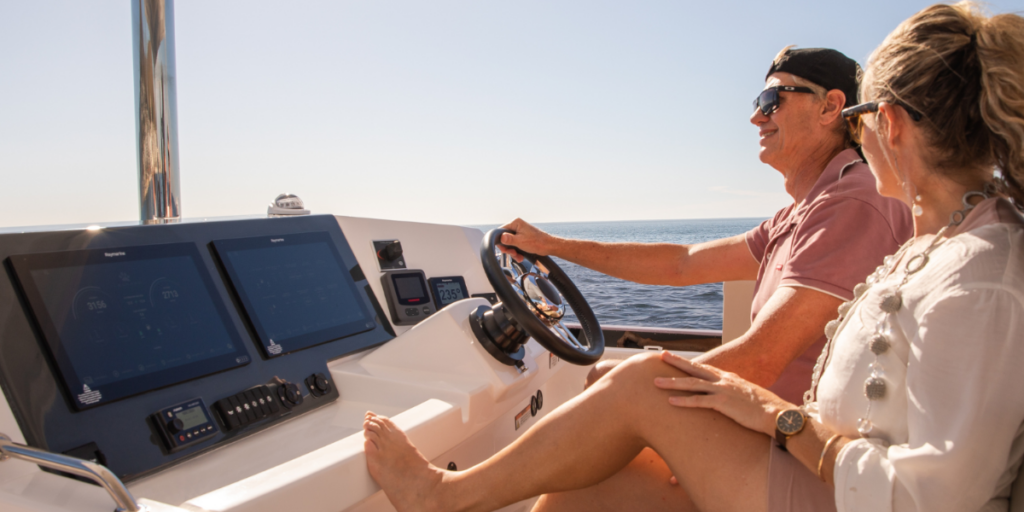
Systems That Make Long-Range Cruising Easier
Hull strength and seakeeping get you offshore. What keeps you cruising for months at a time are the systems beneath the surface: how they’re designed, how accessible they are, and how well they tolerate failure.
When you’re far from support, systems must do two things exceptionally well: keep operating and be serviceable when they don’t. That requirement shapes every serious long‑range cruising yacht.
Redundancy and Reliability
Offshore, redundancy is not a contingency plan—it’s the baseline. Any system that affects safety or habitability must have a true, working backup that can be accessed and used when conditions are already adverse.
At a minimum, that includes propulsion, steering, navigation, communications, bilge management, and power generation.
This is where catamarans offer inherent advantages. Every Leopard sailing catamaran is equipped with twin engines, widely separated in independent hulls. A fouled prop or mechanical failure on one side still leaves full propulsion and maneuverability on the other—an inconvenience rather than a disabling event. Offshore and in tight approaches, that distinction matters.
The same philosophy extends to other systems. Navigation benefits from layered capability rather than single points of failure. Communications require both short‑range and offshore‑capable solutions. Bilge management must function electrically and manually. Power generation must not depend on a single source. Redundancy only works when it is deliberate, simple, and accessible.
Maintenance Access: Designing for the Reality of Offshore Repairs
Redundant systems are useless if you can’t reach them. One of the most common weaknesses in production cruising yachts is poor service access—components buried behind berths, beneath cabinetry, or deep in lockers that must be emptied before work can begin.
Long‑range cruising demands a different approach. Routine service items, filters, and emergency components must be reachable quickly, without dismantling living spaces or working blind in confined areas.
Across the Leopard range, maintenance access is designed around practical offshore use rather than dockside convenience. That philosophy doesn’t just save time during routine checks—it makes real repairs possible when conditions are uncomfortable and time matters.
Prepared cruising isn’t about avoiding failures. It’s about being able to resolve them efficiently when they occur.
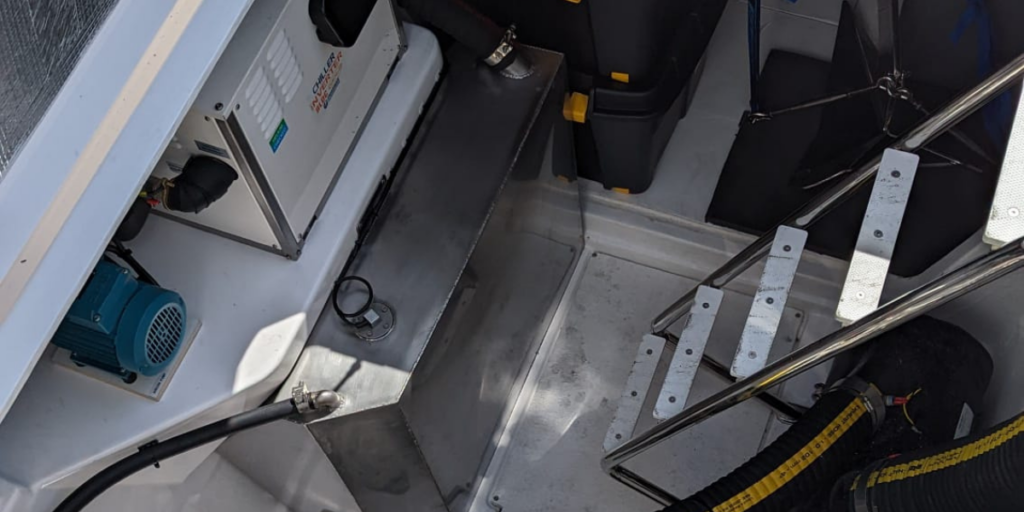
Energy Independence at Anchor
One of the fastest ways to limit a long‑range cruising plan is energy dependence. A modern cruising catamaran running refrigeration, watermaking, navigation, communications, lighting, and ventilation will routinely consume 150–200 amp‑hours per day—before air conditioning enters the equation.
Relying on regular engine or generator runs to meet that demand quickly leads to higher fuel use, increased wear, noise, and a cruising plan dictated by refueling stops. True long‑range independence requires generating, storing, and managing energy as an integrated system—not as an afterthought.
Battery and Solar Strategy
The foundation of any serious offshore energy system is the battery bank. For long‑range cruising, lithium has become the practical standard, not because it’s fashionable, but because the performance advantages are decisive.
Lithium banks provide substantially more usable capacity per rated amp‑hour, recover charge far more efficiently, and weigh less for the energy delivered. Most importantly offshore, lithium’s superior charge acceptance allows solar and alternator input to remain effective throughout the day, rather than tapering off early and leaving the bank perpetually under‑charged.
Solar capacity is equally critical, but integration matters as much as output. Factory‑engineered, flush‑mounted arrays avoid the compromises of bolt‑on solutions and allow energy generation to be treated as part of the yacht’s architecture from the outset. On models like the Leopard 52, this approach enables solar capacity of up to 1,600 watts, integrated directly into the coachroof structure.
Hybrid Systems and Next-Generation Energy
Hybrid propulsion takes energy independence a step further by integrating propulsion, generation, storage, and regeneration into a single architecture rather than a collection of add‑ons.
On the Leopard 46, the optional hybrid system pairs electric drives with solar input, sailing regeneration, shore power, and a range extender. Regeneration begins at low boat speeds and contributes meaningful daily energy while under sail—an ideal match for extended trade‑wind passages.
The Leopard 52’s hybrid system expands this concept further, combining electric drives, dedicated lithium drive batteries with integrated safety systems, a high‑capacity range‑extending generator, and regenerative capability under sail. In both cases, the yacht is designed around the energy system, not retrofitted to accept it.
The result is quieter operation, reduced reliance on fossil fuel, and the ability to remain off‑grid for extended periods without compromising comfort or systems reliability.
Off-Grid Essentials for Bluewater Cruising
For genuine offshore independence, a long‑range cruising yacht should be equipped to meet at least the following baseline:
- Solar capacity: 800W minimum, with 1,200W or more enabling true autonomy on larger yachts
- Lithium battery bank: 400Ah minimum, increasing to 600Ah or more for high‑demand cruising
- Watermaker: 12V‑capable, producing 25 liters per hour or more
- Generator capability: Essential for extended passages, high‑load periods, or hybrid range extending
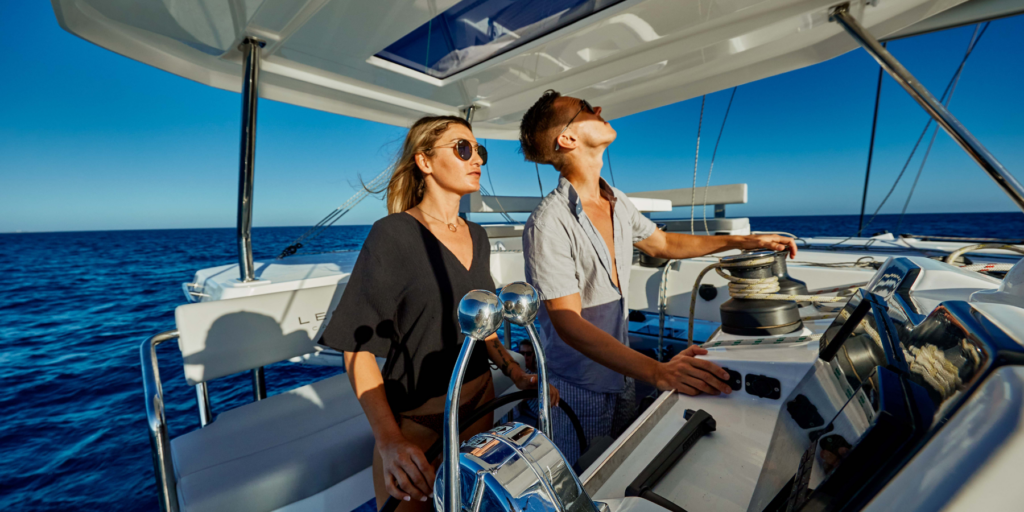
Layout Features That Matter Offshore
The farther you sail from land, the less forgiving your boat becomes. Offshore, layout stops being about style and starts being about function: how safely you can move, how efficiently you can work, and how well the boat supports you when you’re tired, wet, and operating without backup.
A layout designed for long‑range cruising reduces workload, limits unnecessary movement, and keeps critical tasks centralized and secure. Get it right, and the boat works with you. Get it wrong, and even routine actions become exhausting.
Watchkeeping Visibility and Helm Control
Offshore, the watchkeeper’s job is continuous situational awareness: horizon scan, traffic, weather, sail trim, and course control—often alone and often at night. The layout either supports that workload or actively works against it.
A proper offshore helm allows all of this to happen from a single, protected position. Instruments and navigation displays must be readable at eye level, radar and AIS immediately accessible, and sail handling possible without leaving the helm.
Leopard’s helm design concentrates visibility, protection, and control in one place. Elevated helm positions provide clear sightlines, navigation and system controls remain at eye level, and all sail controls are led aft so reefs, trims, and adjustments can be made without abandoning watch. On models like the Leopard 52, a twin‑seat helm enables shared night watches without crowding—an important detail on longer passages.
At sea, the difference between a workable helm and a compromised one shows up quickly.
Ventilation and Interior Flow Offshore
On long passages, interior layout stops being about style and starts being about sustainability. Airflow, movement, and spatial logic determine whether the boat remains livable day after day or slowly becomes draining.
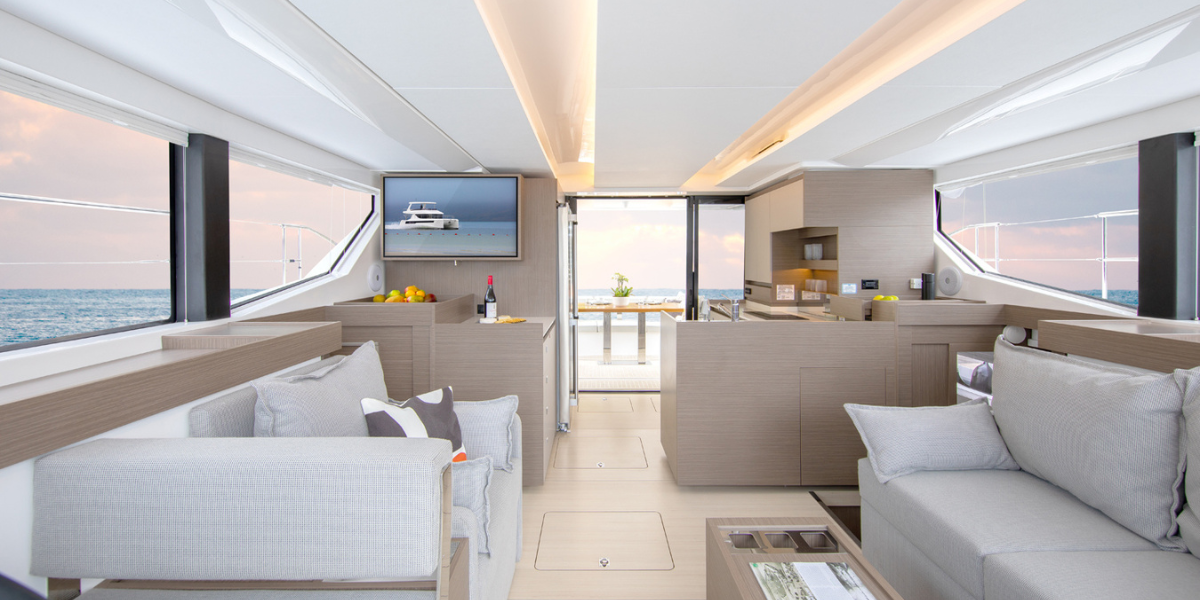
Leopard’s interior layouts prioritize natural airflow and practical circulation when conditions allow, and secure, efficient spaces when they don’t. The connection between cockpit and saloon improves liveability in warm climates, while interior layouts support safe movement and usability underway.
Galley placement is designed around use at sea, enabling secure footing, good orientation with the boat’s motion, and communication with the cockpit rather than isolating the cook below deck. Cabins are positioned away from high‑traffic areas, creating space for genuine off‑watch rest.
Individually, these details seem small. Taken together, they determine whether a crew can maintain routine, rest properly, and stay functional as miles add up.
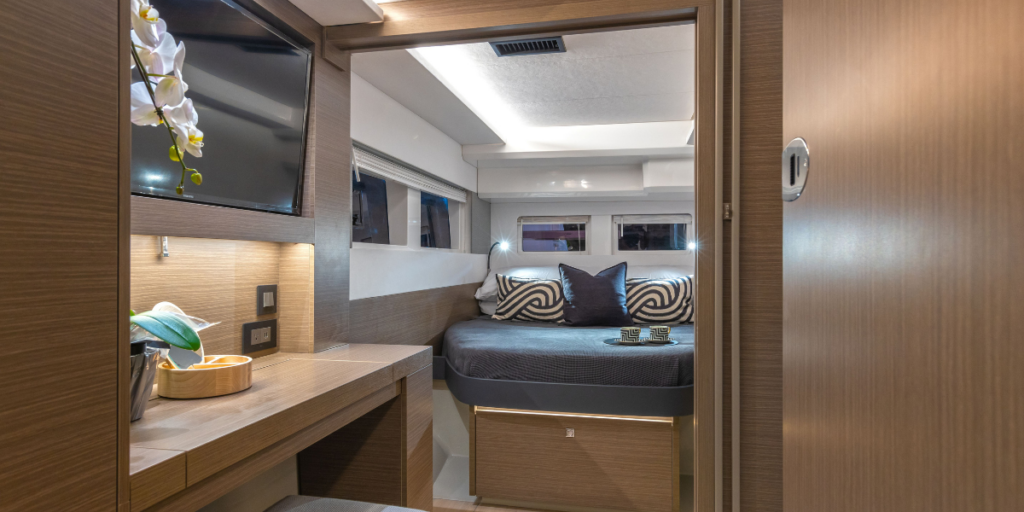
Best Long-Range Setups by Lifestyle
Long‑range cruising looks different depending on who’s aboard. A couple crossing oceans, a family cruising seasonally, and owners prioritizing comfort and speed all place different demands on a yacht’s layout, systems, and workload. The right setup is less about size and more about fit.
Leopard’s range reflects this reality, offering a broad spread of owner‑focused layouts rather than a one‑size‑fits‑all approach to bluewater cruising.
Couples: Simplicity, Manageability, and Autonomy
or couples, the priority is a yacht that can be handled confidently by two people over long distances. Fewer crew means systems need to be intuitive, sail handling centralized, and daily routines manageable without exhaustion.
Most experienced cruising couples gravitate toward:
- A dedicated owner’s layout with one hull reserved for the master suite
- All sail handling led aft for true shorthanded sailing
- Strong energy independence for extended time at anchor
- A utility or technical space in place of excess guest accommodation
Models like the Leopard 43 and Leopard 46 (in owner‑centric configurations) are commonly chosen for this style of cruising, offering manageable size, practical layouts, and systems designed for long periods away from shore. For couples who prefer engine‑driven passagemaking, Leopard’s powercats provide predictable range, redundancy, and speed without reliance on wind windows.
Families: Space, Separation, and Practical Safety
Cruising with children introduces different priorities. Multiple cabins, private heads, usable cold storage, and deck layouts that separate working areas from play and relaxation become essential rather than optional.
For families, the most important considerations are:
- Enough private cabins to give everyone space on long passages
- A saloon that functions as a living area, dining space, and refuge in poor weather
- Storage capacity that supports multi‑week provisioning
- Deck layouts that allow children to be outside without being underfoot during maneuvers
Within the Leopard range, models like the Leopard 46 and Leopard 52, configured with four or more cabins, are commonly chosen for family cruising because they balance layout flexibility, storage volume, and systems capacity without pushing size beyond what most families can comfortably manage offshore.
Luxury-Focused Cruisers: Indulgence Meets Capability
Some owners want to travel long distances without stripping cruising back to its bare minimum. For this group, comfort isn’t about excess—it’s about sustainability: quiet operation, usable living spaces, and systems that support longer stays away from shore.
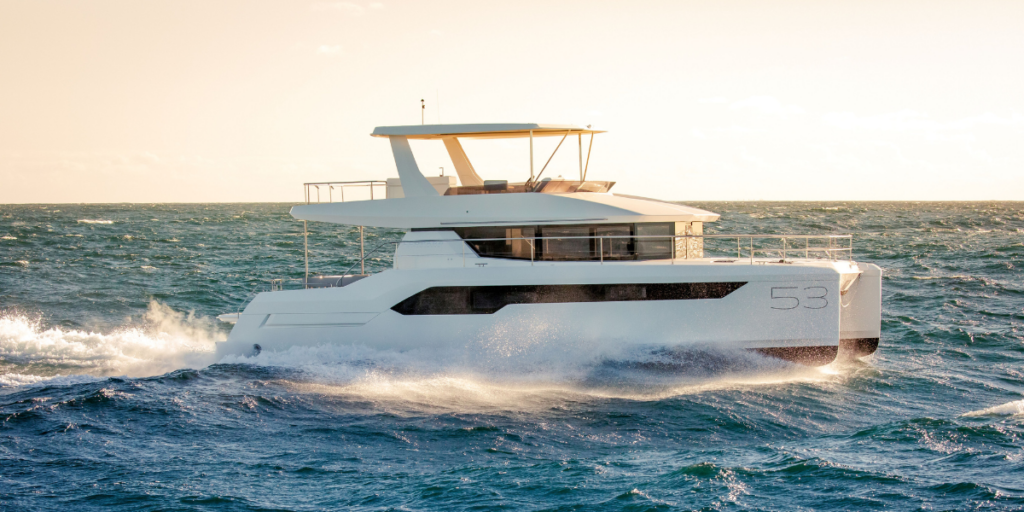
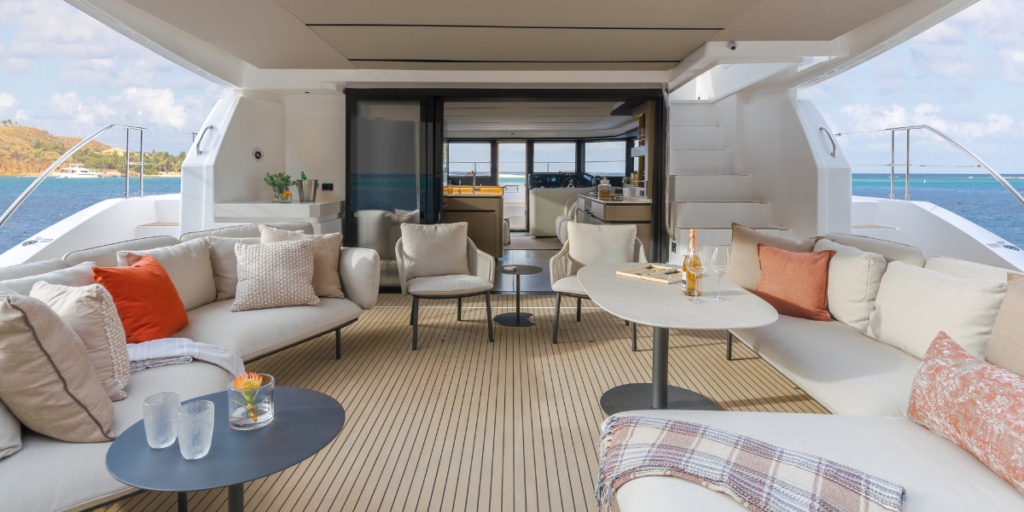
Larger Leopard sailing models, such as the Leopard 46 and Leopard 52, appeal to this style of cruising by pairing offshore‑ready hulls with higher energy capacity, optional hybrid propulsion, and layouts that emphasize liveability at anchor. For owners who prefer engine‑driven passagemaking, the Leopard 53 Powercat offers similar long‑range capability with greater speed, reduced reliance on wind windows, and the space and stability associated with a true power multihull.
How to Evaluate Yachts During Tours and Sea Trials
A long‑range cruising yacht should be evaluated as a system, not a showroom. A sea trial is not a formality or a pleasure cruise—it’s your only opportunity to test whether a boat is genuinely prepared for offshore life.
Think of the evaluation in three phases: at the dock, underway, and at anchor. Each one reveals different strengths and weaknesses. Skipping any of them is how buyers end up compromising offshore with a boat they loved at the dock.
At the Dock: Access, Storage, and Serviceability
Before engines start, focus on what matters offshore: storage that works, systems you can reach, and problems you can realistically solve at sea.
- Storage: Open lockers and reach into the deepest corners. Is the space genuinely usable for provisions, spares, and tools, or is it awkward volume that looks good but loads poorly?
- Engine and systems access: Get hands‑on with service points like filters, belts, strainers, and impellers. If routine checks require removing cushions or emptying lockers, that’s a real long‑range liability.
- Seacocks and bilge systems: Locate every through‑hull, bilge pump, and switch. Confirm you can reach and operate them quickly and safely.
If basic maintenance feels inconvenient at the dock, it will feel punishing offshore.
Underway: Motion, Control, and Systems Under Load
This phase reveals how the yacht behaves when it’s doing the job it’s meant for.
- Upwind motion: In real breeze and chop, pay attention to bridgedeck behavior. Note both the frequency and severity of any slamming and ask whether you could tolerate this motion for multiple days.
- Interior usability underway: Go below while the boat is sailing. Walk the saloon, galley, cabins, and heads. Can you move safely? Can you brace naturally? Does the layout still work when the boat is in motion?
- Autopilot performance: Engage the autopilot on different points of sail. Boats that wander or over‑correct increase energy consumption and crew fatigue over long passages.
- Electronics under combined load: Run navigation, radar, AIS, autopilot, instruments, and communications simultaneously. Offshore, these systems run together continuously—this is where weak integration shows up.
The key question underway isn’t speed. It’s whether the boat remains stable, predictable, and manageable when conditions and fatigue start to stack up.
At Anchor: Liveability and Energy Reality
At anchor, you find out whether the boat works as a home, not just as a sailing platform.
- Ventilation: Open the boat the way you realistically would at anchor and observe airflow through the main living space. Good ventilation is felt quickly, not explained later.
- Energy reality: Run typical daily loads and observe battery behavior and charging performance. Small shortfalls become daily deficits offshore.
- Galley function: Simulate preparing a real meal. Can the cook brace comfortably? Is the workspace usable when other people are moving through the boat?
- Rest and sleep: Spend time in the cabins. Evaluate airflow at berth level, noise transfer, and separation from high‑traffic areas.
End this phase with one simple question:
After a week at this anchorage, would you feel ready to set off on another multi‑day passage?
If the answer is yes, you’re close to the right boat.
Get The Most From Your Sea Trial: Insider Tips for Evaluating Long-Range Cruising Yachts
A sea trial only works if you arrive prepared. The goal isn’t to be impressed—it’s to confirm whether the yacht actually matches how you plan to cruise long‑term. These three steps will help you get real value out of the experience.
1. Do your research before you arrive
The most reliable insight into any long‑range cruising yacht comes from owners who’ve lived aboard and put serious miles under the keel. Before your sea trial, spend time reading firsthand accounts from sailors who have crossed oceans, completed extended passages, or lived aboard for multiple seasons.
Owner interviews, delivery skipper reports, and long‑term cruising stories provide context no specification sheet can. Independent third‑party guides from established offshore sailing publications can also help frame what matters—and what doesn’t—before you ever step aboard.
Arriving informed sharpens your questions and keeps the sea trial focused on realities rather than impressions.
2. Evaluate sailing and power catamarans on their own terms
If you’re undecided between sail and power, sea trial both—ideally in similar conditions. Each supports a different long‑range cruising style.
Sailing catamarans prioritize efficiency, extended range under sail, and the rhythm of wind‑driven passagemaking. Power catamarans offer consistent speed, predictable arrival times, and independence from wind patterns, with fuel planning becoming the primary range consideration.
Neither is universally better. The right choice depends on where you plan to cruise, how you prefer to travel, and which kind of passage you’ll enjoy repeating year after year.
3. Talk to a Leopard consultant before you book
A conversation before the sea trial often matters more than one afterward. A Leopard consultant can help narrow model selection, layout configuration, and system specification based on your real cruising goals—so you’re evaluating the right boat from the start.
That upfront alignment avoids wasted sea time on a yacht that was never a fit and helps frame the trial around the decisions that actually matter offshore.
What it comes down to:
The best long‑range cruising yacht isn’t the most impressive one tied to the dock. It’s the one that still feels right after a week at sea, with tired crew, full tanks, and the nearest marina days away.
Use the sea trial, owner experience, and informed guidance to make that call with clarity—not hope.
The Best Long‑Range Cruising Catamaran Is Built for the Ocean
Long‑range cruising rewards substance, not showmanship. Offshore seakeeping, structural integrity, accessible systems, smart storage, and true energy independence matter far more than dockside impressions.
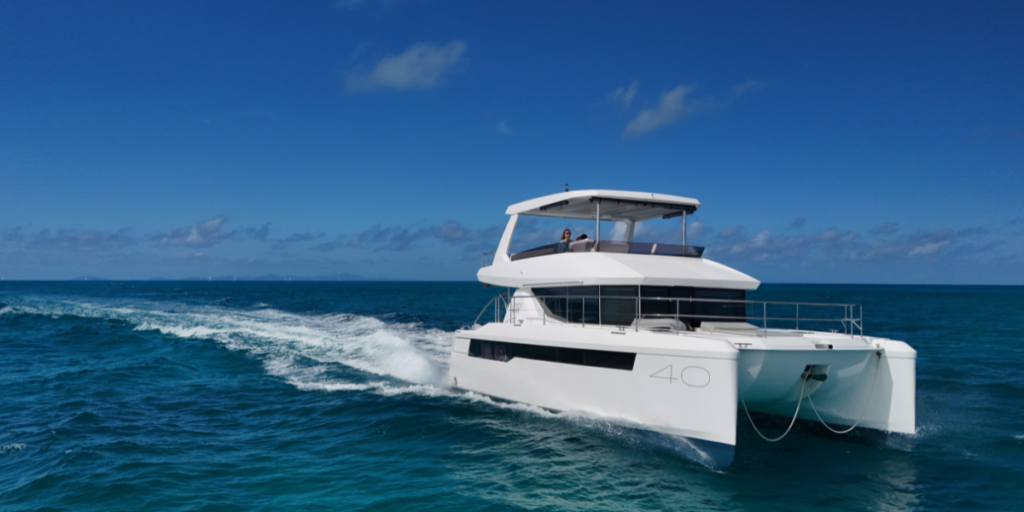
Leopard Catamarans have been refined through decades of offshore use and thousands of owners sailing real miles on every ocean. That experience shows up not in marketing claims, but in boats that continue to perform when conditions are demanding, and support is far away.
The right long‑range cruising catamaran isn’t the one that looks best at the dock. It’s the one that still feels right weeks at sea, with a tired crew, full tanks, and the next marina days away.