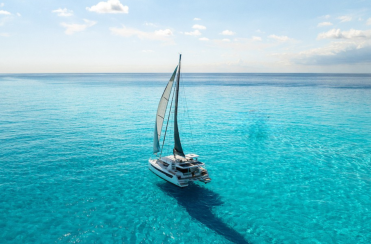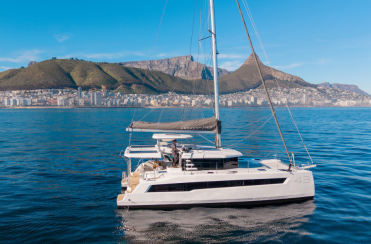
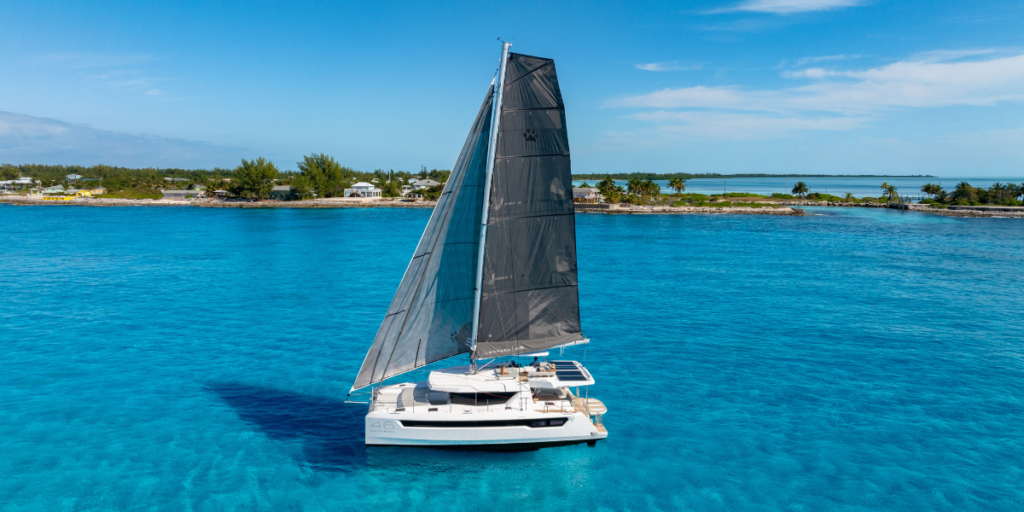
Somewhere along the way, the sailing world decided that bluewater catamarans and beginners don’t belong in the same sentence. That you have to somehow first earn your offshore stripes on something smaller, simpler, and less capable before you’re even allowed to think about a boat that can cross an ocean. It sounds responsible. It even sounds wise. But it’s made more sailors second-guess themselves than bad weather ever has.
The real issue has never been whether beginners belong on bluewater catamarans or not. It’s simply all about what happens when you buy the wrong bluewater boat. Because the wrong boat doesn’t just slow your learning curve, it quietly chips away at your confidence until your dream starts to feel like a mistake. A catamaran with systems you can’t understand or a rig you can’t manage is not a steppingstone. It’s a wall. And too many first-time owners hit this wall before they even set off on their first long-range voyage.
So, can you actually find a bluewater sailing catamaran that’s built for beginners? One that keeps things simple without dumbing anything down? One that grows with you instead of overwhelming you from day one? Absolutely, you just have to know what to look for, what to walk away from, and how to tell the boats that are genuinely designed to support new owners apart from the ones that just look the part on paper.
That’s exactly what this guide is for. We’re breaking down what “beginner friendly” really means when it comes to bluewater catamarans, which features actually matter when you’re still learning, the mistakes that trip up first-time owners again and again, and how to set yourself up for a confident, capable first year out on the water.
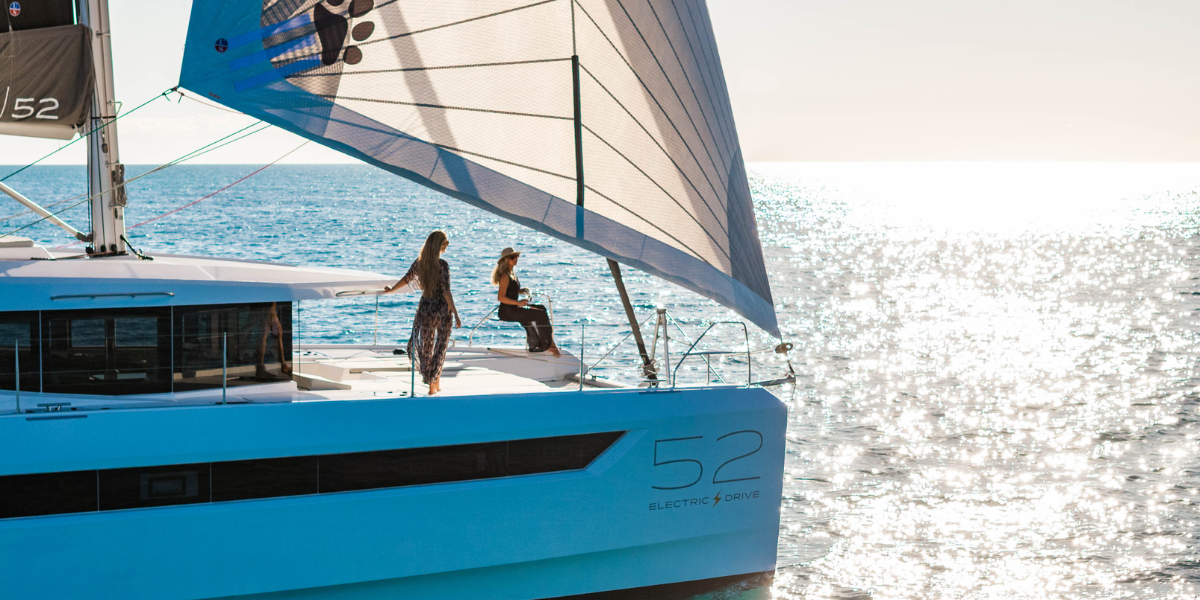
What “Beginner” Really Means in Bluewater Sailing
In bluewater sailing, “beginner” is one of the most misleading labels in the entire industry. Mention that you are a beginner at a dock party and you’ll probably get a knowing look from the guy who’s been cruising for thirty years and still hasn’t left the intercoastal waterways, or the couple that’s been about to start their circumnavigation for the last five years, yet still just keeps chartering yachts with a skipper in the Caribbean.
For some, beginner means stepping onto a boat for the very first time and learning what wind actually feels like when it fills a sail. For others, it means years of charter holidays, flotilla sailing, or coastal cruising without ever having taken full responsibility for a yacht of their own.
Simply put, it’s not a fixed category, it’s a spectrum. And each of these beginner journeys has its own learning curve and its own definition of what “the right boat” actually looks like.
Beginner Sailor vs Beginner Owner: They’re Not the Same Thing
This might seem like a minor distinction at first, but it matters more than most people think. A beginner sailor is still building fundamental skills, like learning how to trim sails, reading the weather, understanding how navigation instruments work, feeling comfortable anchoring in different environments, and not having a mild panic attack every time you need to dock your boat. Whilst a beginner owner might have years of sailing miles or even a sailing certification, but has never owned, provisioned, maintained, or managed a yacht as their own.
Both are beginners. But their bluewater sailing needs are very different.
It’s a reality Leopard 44 owners Eileen and Brown Councill, who moved aboard their catamaran with no prior liveaboard experience and went on to become full-time bluewater cruisers, know all too well: “No matter what you know, you’ve got to give yourself a lot of grace and be patient and realize the learning curve is going to be steep; a good sense of humor is essential.” That kind of honest, hard-won perspective is the reason your boat matters so much. The right catamaran gives you the room to be patient with yourself, because it isn’t fighting you every step of the way.
A beginner sailor, specifically, needs a catamaran that is forgiving, intuitive, and designed to build confidence progressively. Systems should be simple and easy to maintain. One person should be able to handle the sails comfortably by themselves, and the helm should offer excellent visibility and protection.
A beginner owner, meanwhile, may already be comfortable at the helm but is now navigating an entirely new landscape of insurance, maintenance schedules, provisioning logistics, and system management. For this buyer, the right catamaran isn’t necessarily the simplest one. It’s the one where every system is accessible, well documented, and designed for real-world servicing.
Regardless of which category you fall into, the best bluewater catamarans for every type of beginner shares one thing in common: they don’t punish you for still learning and reward growing confidence with genuine capability.
Learning Progression: The Boat Should Grow With You
One of the most common traps new long-range cruising catamaran owners fall into is buying a boat that matches where they are right now, rather than where they want to be in two or three years. And on the opposite end of the spectrum, some beginners leap straight into a complex offshore machine that demands a skill set they haven’t built yet.
The sweet spot is a catamaran that meets you where you are today but doesn’t hold you back tomorrow. A boat that feels manageable on your first weekend trip, capable on your first island hop, and confident when you’re finally ready to point the bow toward open water.
This is where thoughtful design matters far more than sheer size or spec sheet numbers. A well-designed beginner-friendly catamaran should offer simple, cockpit-led sail handling that becomes second nature quickly. Systems that are transparent and easy to understand, so that learning to manage them builds confidence rather than anxiety. And a layout that functions well for both short coastal hops and eventual bluewater cruising.
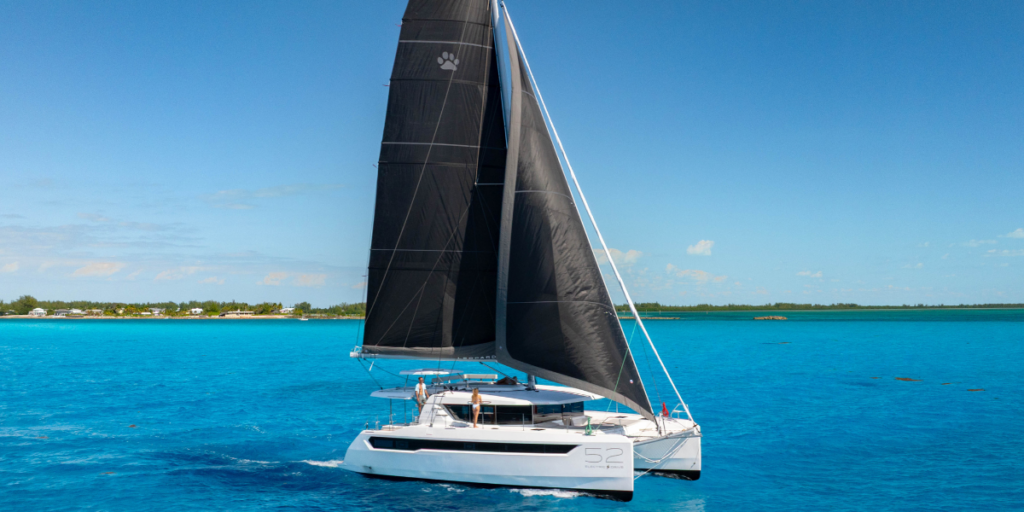
The Leopard sailing catamaran range is specifically designed around this philosophy. From the manageable Leopard 43 through to the spacious and luxurious Leopard 52, every model in the range shares the same intuitive cockpit-led sailing DNA, the same protected helm design, and the same accessible systems architecture. Which means the skills you build on one Leopard transfer directly to the next. Ensuring your learning curve stays smooth, even as your ambitions grow.
It’s a philosophy that has produced over 3,100 Leopard catamarans delivered to owners worldwide across more than three decades. And among that fleet are countless first-time owners who have gone on to complete Atlantic crossings, Pacific passages, and full circumnavigations on boats they bought as beginners.
That track record has also translated into one of the most awarded catalogues in the catamaran industry. Leopard Catamarans have collected honors across virtually every major international sailing award over the past three decades, including Cruising World’s Boat of the Year, SAIL Magazine’s Best Boats, Multihull of the Year, and European Powerboat of the Year. In 2025 alone, the new Leopard 46 won both theMultihull of the Year Sail Cruising Award and earned a spot on SAIL Magazine’s Top 10 Best Boats list.
For a first-time buyer, awards like these cut through the noise. When the same boats keep earning recognition from the people who test catamarans for a living, you don’t have to guess whether you’re making the right call.
What Makes a Catamaran Beginner Friendly?
“Beginner friendly” doesn’t mean stripped down, underpowered, or designed for intercoastal water only. It means the boat removes unnecessary complexity so you can focus on what actually matters: learning to sail well, managing your systems confidently, and building the kind of competence that turns a nervous new owner into a relaxed, capable cruiser.
The features that genuinely make a bluewater catamaran beginner friendly aren’t the ones that get the biggest font on the brochure. They’re the ones you notice on your tenth sail, not your first. The ones that prevent small mistakes from becoming big problems. And the ones that let you handle the boat confidently with a small crew, in real conditions, without feeling like you’re constantly at the edge of your ability.
Simple Sail Handling: Confidence Starts With the Rig
If there is one single feature that defines whether a catamaran will build a beginner’s confidence or destroy it, it’s the sail handling system. Everything else, the interior, the galley, the electronics, all of it becomes secondary the moment conditions change and you need to reef, furl, or adjust your sails quickly and safely.
For a beginner, look for a catamaran that is designed with all the lines that control the sails leading aft to the helm. When all halyards, sheets, and reefing lines run back to the cockpit and are easily accessible, a single person can raise, trim, reef, and furl every sail without leaving the helm. That means you don’t need extra crew to make a sail change, and a sudden squall won’t cause a panicked scramble to the foredeck.
Leopard Catamarans have made this a standard design principle across their entire sailing range. All sail controls lead aft to three electric winches at the helm, which means that whether you’re sailing a Leopard 43 or a Leopard 52, the muscle memory is the same. Raise, trim, reef, furl, all from one protected position. For a beginner, that consistency is invaluable because it means the boat works with you instead of demanding that you work around it.
Electric winches deserve a specific mention here, because they are not a luxury item on a beginner’s boat. They are a practical safety feature. Manually grinding a winch in 20 knots of breeze while trying to maintain course and watch the horizon is a recipe for disaster. Electric winches remove the physical strain, allowing you to make faster, calmer decisions when conditions demand quick sail adjustments.
Visibility and a Protected Helm: See Everything, Fear Nothing
Confidence at the helm is built on two things: being able to see clearly in every direction and being protected enough to stay comfortable while you do it. For a beginner, both are critical because a helm station that offers poor visibility or leaves you exposed to spray and weather doesn’t just make sailing unpleasant, it makes solo night watches something to dread, and the fear of docking might make you never want to leave the dock in the first place.
A well-positioned helm on a bluewater catamaran should give you unobstructed sightlines forward, to both bows, along the beam, and aft to the stern quarters. You should be able to see your sail trim, your dock approach, oncoming traffic, and your crew on deck without leaving your seat. Any structural pillar, canvas enclosure, or hardtop design that creates a blind spot is a compromise you’ll pay for every time you enter a crowded anchorage or navigate a busy shipping lane. Equally important is protection. Extended time at the helm in tropical sun, driving rain, or salt spray isn’t character building. It’s just exhausting.
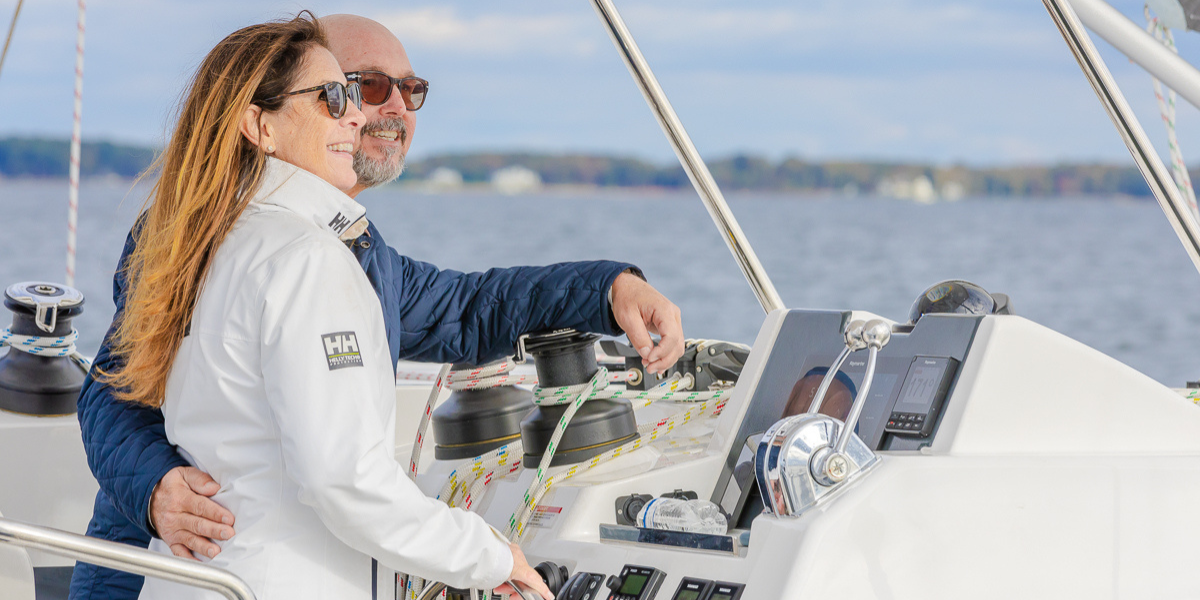
Leopard’s helm design is purpose-built around both of these priorities. The elevated, forward-positioned helm across the entire Leopard range delivers genuine 360-degree visibility, and a protective hardtop with fold-up rain covers shields the skipper from sun, spray, and rain without compromising sightlines.
And ergonomically placed controls and instrument panels mean you can manage sails, navigation, and engine controls without ever stepping away from the helm. It’s a setup that independent reviewers consistently praise. After taking the Leopard 46 for a test run, marine journalist Mark Pillsbury gave the Leopard helm design his seal of approval: “The helm, raised to deck level and protected from weather by a hardtop Bimini, was comfortable. From the two-person driver’s seat, I found good all-round visibility, and all sail-control lines were close at hand and easily managed by the electric Harken winches on the cabin top.” When one of the industry’s most experienced boat reviewers describes the helm exactly the way a beginner needs it to be, you’re looking at more than a marketing promise.
For a beginner, this kind of helm environment makes you feel in control. And feeling in control is the foundation of every good decision you’ll make at sea.
Docking Predictability: The Moment That Tests Every New Owner
Ask any new catamaran owner what moment generates the most anxiety, and nine out of ten will say the same thing: docking. It’s the one scenario where everything happens slowly enough for spectators to watch (and gives them enough time to take out their cameras), and yet also happens quickly enough for things to go sideways really fast.
And for a beginner, the difference between a boat that docks predictably and one that surprises you in tight quarters is the difference between a confident afternoon and a story you’d rather forget.
The good news is that catamarans, by design, are easier to maneuver in close quarters than monohulls. Twin engines, widely spaced in separate hulls, give you a level of directional control that a single-engine yacht simply cannot match. By applying differential thrust, one engine forward and one in reverse, you can pivot a catamaran in virtually its own length. Crosswinds that would push a monohull helplessly off course can be managed with calm, precise throttle adjustments.
But not all twin-engine setups feel the same. What separates an intuitive docking experience from a stressful one comes down to throttle response, helm visibility, and the overall predictability of the platform. Leopard catamarans are consistently praised by owners for how intuitive they feel in marinas and tight anchorages, and the sailing press has reached the same conclusion for years. In a SAIL Magazine boat review of the Leopard 45, reviewers noted that “close maneuvers were also perfect, with a turning circle of about one boatlength, a pirouette in its own water with engines running in opposite directions and precise stopping and backing. Docking is simple and predictable.”
The elevated helm provides clear sightlines to both stern quarters and along both hulls, exactly where your eyes need to be when you’re threading between pilings. Throttle response is linear and predictable, and the wide beam provides a stable platform that doesn’t get pushed around by beam winds the way a narrower catamaran might.
For a beginner, that predictability is everything. Because when you know how the boat will respond before you apply the throttle, docking stops being a test and starts being routine. And that’s exactly what it should be.
What Makes a Catamaran Bluewater Capable?
Being beginner-friendly gets you on the water confidently. Being bluewater capable keeps you safe when the water gets serious. And understanding the difference between the two, and insisting on both, is what separates a smart first purchase from one you’ll outgrow or, worse, one that lets you down when conditions deteriorate.
A bluewater-capable catamaran isn’t simply a bigger version of a coastal cruiser. It’s a fundamentally different proposition, built around structural resilience, comfort in demanding sea states, and the self-sufficiency to operate independently for extended periods far from shore. And the best bluewater catamarans for beginners are the ones that deliver all of this without burying you in complexity.
Structure and Safety Fundamentals: What’s Beneath the Gelcoat
“The performance was amazing, even in 12-foot waves and rough seas. Nothing broke, and we didn’t get water ingress anywhere.” That’s how Leopard delivery captain Guilherme Kodja, a veteran with over a decade of ocean miles on virtually every Leopard model, described one of his Atlantic crossings aboard a fully loaded Leopard 46.
For a beginner, that kind of testimony from someone who delivers catamarans across oceans for a living is worth far more than any spec sheet. Because the structural integrity of your catamaran is the one thing you cannot upgrade, retrofit, or fix after the fact. Everything else, electronics, sails, interior finishes, can be changed. The hull construction and engineering are permanent. So, understanding the basics of what makes a hull genuinely bluewater worthy isn’t optional reading, it’s the foundation of what it takes to cross oceans.
Let’s start with the construction method. Vacuum-infused hulls are the current gold standard for production catamarans. The process produces a stronger, lighter, and more consistent laminate than traditional hand-layup by removing excess resin and compressing the fiber layers under vacuum pressure. The result is a hull that’s stiffer, more impact-resistant, and lighter for its strength, all of which directly translate into better performance, better fuel efficiency, and a safer platform offshore.
Bridgedeck clearance is the next structural consideration that every beginner should understand. The bridgedeck is the flat underside of the platform connecting the two hulls, and when waves strike it, the result is a jarring, sometimes violent, slam that reverberates through the entire boat. Adequate clearance between the waterline and the bridgedeck reduces the frequency and severity of these impacts, making passages quieter and more comfortable.
Leopard Catamarans are built using vacuum-infused construction as standard across the entire range, delivering the strength-to-weight ratio that serious offshore sailing demands. Bridgedeck clearance is treated as a fundamental design priority rather than a concession to interior volume. Leopard is the only catamaran brand in the world to hold dual certification to both NMMA/ABYC and CE standards simultaneously, a safety credential that reflects not just regulatory compliance but a genuine commitment to building boats that perform safely on any ocean.
For a beginner, these aren’t specs to memorize. They’re the foundation of trust. When you’re 500 miles offshore and a weather system arrives that you didn’t anticipate, the construction beneath your feet is either working for you or it isn’t.
Comfort in Waves: Why It’s a Safety Feature, Not a Luxury
Comfort at sea gets dismissed as a soft concern, something for fair-weather sailors who care more about cushions than capability. That’s a dangerous misunderstanding. Offshore, comfort is directly linked to safety because a crew that can’t sleep, can’t cook, and can’t function is a crew that makes mistakes. And mistakes offshore have consequences that don’t exist in coastal waters.
How a catamaran moves through waves, how it absorbs swell, responds to chop, and behaves in a quartering sea, determines how well the people aboard can sustain themselves over days and weeks at sea. A boat that slams its bridgedeck into every wave will exhaust its crew, and one that rolls excessively at anchor can make sleep nearly impossible.
For a beginner especially, predictable and forgiving motion at sea is critical. You’re still developing your sea legs, still learning to read conditions, and still building the instincts that experienced sailors rely on. A catamaran that moves smoothly and predictably gives you the space to learn, adapt, and make good decisions rather than simply survive the passage.
Leopard’s wide beam and hull separation create a platform that fundamentally resists the rolling motion that destroys sleep and erodes morale on long passages. The stepped hull design minimizes bridgedeck slamming, and optimized weight distribution keeps motion smooth and predictable even when the boat is fully loaded for an extended voyage. The result is a ride that doesn’t fight the ocean but moves with it, keeping the crew functional, alert, and genuinely comfortable rather than merely coping.
When you’re evaluating bluewater catamarans as a beginner, don’t just think about how the boat sails and feels during your 60 min sea trial. Think about how it is going to sail and feel on hour 36 of a passage, in 20 knots with a confused swell.
Energy and Water Basics: True Self-Sufficiency at Sea
One of the steepest learning curves for any new catamaran owner isn’t sailing. It’s energy management. Understanding how much power your boat consumes daily, where that power comes from, and how to keep the balance sheet positive without running a generator every few hours is a skill that takes most owners an entire season to develop. And a well-designed catamaran should make that learning process intuitive rather than overwhelming.
The fundamentals are straightforward. A modern cruising catamaran running refrigeration, navigation instruments, a watermaker, lighting, and communication systems will consume roughly 150 to 200 amp-hours of battery capacity per day. Add air conditioning and that figure can double. The question for every new owner is simple: where does that energy come from, and can you generate enough of it without being tethered to a marina or running your engine constantly?
Solar panels are the backbone of any serious off-grid energy setup. Factory-integrated solar arrays, flush-mounted and wired into the boat’s electrical architecture from day one, perform more reliably and efficiently than aftermarket bolt-on installations. Lithium battery banks store more usable energy than traditional AGM batteries, charge faster, and deliver consistent power across a wider range of discharge. And a watermaker turns seawater into freshwater at the push of a button, extending your cruising range from days to weeks without the anxiety of rationing your water supply or taking weekly instead of daily showers.
For a beginner, the key isn’t memorizing amp-hour calculations. It’s choosing a catamaran where these systems are already intelligently integrated, clearly monitored, and designed to work together without constant manual intervention.
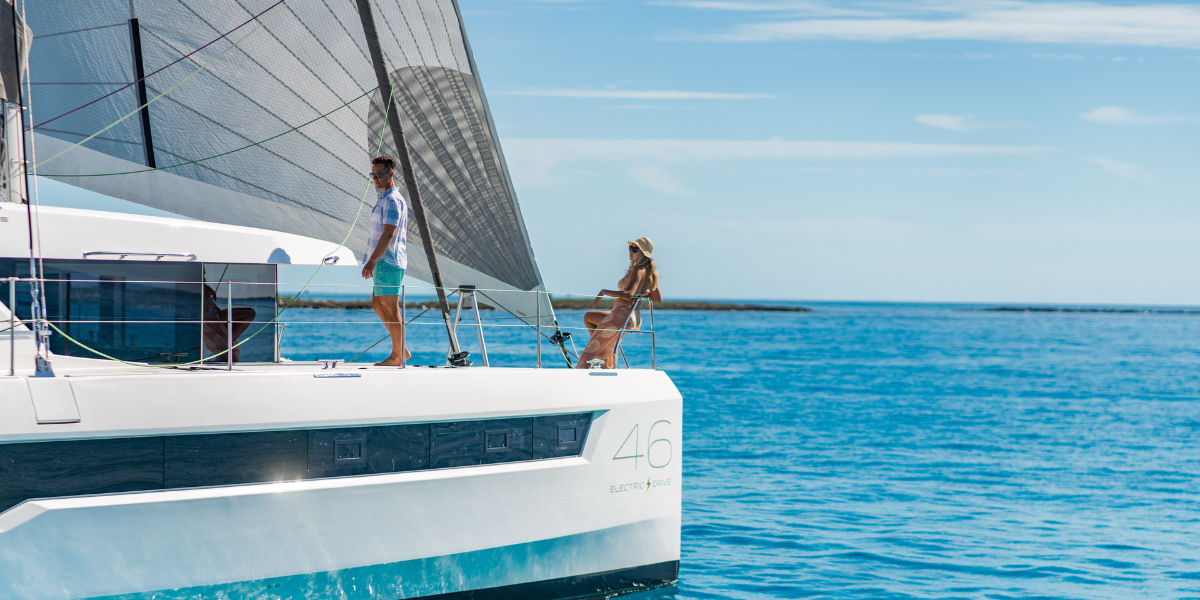
The Leopard 46 exemplifies this approach. Factory-integrated solar, lithium battery banks, and an optional hybrid electric drive system combine to create an energy architecture that supports genuine off-grid independence without requiring an engineering background to operate.
Smart battery management systems monitor charge and discharge automatically, and the optional hybrid system even regenerates energy while sailing, feeding power back into the bank from just 4 knots of boat speed. For a beginner owner, that kind of integrated, largely self-managing energy system removes one of the most intimidating aspects of catamaran ownership and replaces it with easy to understand reliable autonomy.
Fresh water follows the same principle. Leopard’s watermaker systems are designed for simplicity and reliability, with smart placement for easy monitoring and routine maintenance. Press a button, make water, keep cruising. No rationing. No stress. No detour to a marina just to fill tanks.
The boats that support beginners best aren’t the ones with the simplest systems. They’re the ones with smart systems, designed to be understood, monitored, and managed by someone who’s still learning, without sacrificing the capability that bluewater cruising demands.
Common Mistakes Beginners Make When Buying a Bluewater Catamaran
Every experienced cruiser has a long list of things they wish they’d known before buying their first boat. But luckily most of the mistakes that trip up first-time owners are all the same and entirely avoidable if you’re honest with yourself about where you are in your journey, and what you actually need versus what just looks impressive on a spec sheet.
Buying Too Large or Too Complex
This is the most common and most costly mistake new catamaran owners make. And it’s driven by a logic that actually sounds perfectly reasonable: buy the biggest boat you can afford so you don’t outgrow it. More space, more cabins, more systems, more capability. What could go wrong? Quite a lot, as it turns out.
A catamaran that’s too large for your current skill level doesn’t just feel overwhelming. It actively slows your development as a sailor. Larger boats demand more precise maneuvering in marinas. They carry more complex electrical, plumbing, and rigging systems. Their sails generate more load, requiring more physical effort or more reliance on powered systems you may not fully understand yet. And every system you don’t understand is a system you can’t troubleshoot when it fails, which, offshore, it will.
The result is an owner who never quite relaxes on their own boat. Who dreads docking days. Who avoids pushing into new waters because the complexity of the vessel has become a source of stress rather than freedom.
The smarter approach is to match boat size to your current capability with room to grow, not to your ultimate fantasy. A well-designed 42 to 46-foot catamaran offers genuine bluewater capability, comfortable liveaboard space, and manageable systems complexity for a new owner. It’s large enough to cross oceans and small enough to handle confidently with a crew of two.
Complexity follows a similar principle. A catamaran loaded with integrated electronics, hybrid systems, watermakers, generators, and advanced power management is genuinely capable. But if you don’t understand how those systems interact, you’ll spend your first-year troubleshooting rather than sailing. Start with systems you can learn thoroughly and add complexity as your knowledge catches up with your ambition.
Underestimating Ownership Costs
Ongoing ownership costs scale with the size, complexity, and cruising plans of your catamaran, and they add up faster than most new owners expect. Insurance premiums are influenced by vessel value, cruising region and owner experience. First-time owners with limited offshore experience may face higher premiums or additional certification requirements, particularly for hurricane-zone cruising.
The sheer cost of annual maintenance alone is one of the biggest expenses that catch most beginner owners and sailors off-guard. Haul-outs, antifouling, sail and rigging inspections, engine servicing, and ongoing system upkeep including plumbing, electrical, and refrigeration all contribute to a realistic annual maintenance budget. A common rule of thumb is to budget approximately 10% of the boat’s value per year for this sort of maintenance and upkeep, though this varies depending on how heavily the boat is used and how hands-on you are as an owner.
Marina costs are another big thing to consider, as catamarans, with their wider beam, typically require larger berths that come at a premium. In popular cruising grounds like the Caribbean or Mediterranean, availability during peak season can be limited, and pricing reflects that demand. This can influence not just your budget but your itinerary and cruising flexibility.
Then there are the costs that don’t appear on any spreadsheet: the afternoon spent troubleshooting an electrical issue instead of exploring a new anchorage. The unplanned haul-out that disrupts a season. The upgrade you didn’t budget for but can’t live without after your first long passage.
None of this should discourage you from buying a long-range cruising catamaran. But it should encourage you to plan realistically. The smartest beginner buyers factor ongoing costs into their decision from the start, choosing a catamaran that aligns not only with their sailing goals but with their long-term financial comfort.
A Realistic First-Year Ownership Plan
Buying the right catamaran is only half the equation. What you do in your first twelve months of ownership will shape your confidence, your capability, and your entire relationship with your boat for years to come.
The best approach isn’t to dive straight into a transatlantic crossing. It’s to build your skills gradually, learn deliberately, and let each experience prepare you for the next. Here’s what a realistic first year looks like for a new bluewater catamaran owner.
The Month-by-Month Timeline: Building Skills, Confidence, and Range
Months 1 through 3: Learn your boat, not the ocean.
Spend your first few months sailing in familiar, forgiving waters. Day sails, weekend anchorages, and short coastal hops or intercoastal cruising. The goal isn’t distance. It’s intimacy with every system on board.
Learn how your sails set and trim in different wind angles. Practice docking until it feels natural and your heart rate stops jumping up. Run every system, solar, watermaker, generator, and understand the basics of your energy budget. Change an impeller. Bleed a fuel line. Find every through-hull and know how to close it in the dark. These aren’t glamorous or exciting milestones, but they’re the ones that build genuine confidence.
Months 4 through 6: Make The Boat Yours
Start extending your range. Plan your first multi-day passage, even if it’s just an overnight hop to a nearby island group or an 12-hour coastal sail to a different marina. Practice anchoring in different conditions and different bottom types.
Cook underway. Sleep underway. Experience what the boat feels like on hour 18 of a passage, not just hour two. Introduce night sailing in controlled conditions, with a clear sky and light traffic, and get comfortable with the rhythms of watchkeeping. This is where the boat stops being new and starts being yours.
Months 7 through 9: Build operational independence.
By now you should have sailed enough miles that handling the boat isn’t the challenge anymore. The challenge becomes self-sufficiency.
This is the time where you should be focusing on building confidence in living off the grid. Provision for a week at anchor without marina support. Monitor your energy and water consumption over multiple days and learn where your usage patterns create surpluses or deficits. Practice basic troubleshooting under realistic conditions. The goal is to reach a point where being away from a marina for a week feels normal, not adventurous.
Months 10 through 12: Plan your first real passage.
With almost a full year of experience behind you, it’s time to start planning your first serious offshore leg. Whether that’s a multi-day island crossing, a coastal passage with an overnight component, or the first leg of a longer cruising plan, approach it with the preparation and respect it deserves. Carefully assess the weather and choose the ideal weather window. Prepare and provision the boat for offshore conditions and brief your crew on the cruising plan, watch schedule and what to do in an emergency situation.
And when you set off, trust the preparation, trust the boat, and trust the skills you’ve spent a year building.
This isn’t a rigid schedule. Some owners will move faster, others will take longer, and both approaches are perfectly valid. The point is progression, not speed. A beginner who spends twelve months methodically building their skills and knowledge will be a more confident, more capable, and a safer sailor than someone who rushed through their first season chasing miles.
And this is precisely where choosing the right catamaran from the outset pays dividends. A boat that’s intuitive to handle, transparent in its systems, and designed for the realities of shorthanded cruising doesn’t just make your first year easier. It makes it more enjoyable. And enjoyment, more than any certification or course, is what keeps you sailing.
Which Leopard Is The Best Bluewater Sailing Catamaran for a Beginner?
With a shared design concept across the entire range, every Leopard is genuinely approachable for a new owner. But certain models are better matched to specific beginner profiles, budgets, and ambitions. Here’s how the range breaks down for first-time buyers.
- The Best Bluewater Catamaran for First-Time Owners and Budget-Conscious Buyers: The Leopard 43 is the most accessible entry into genuine bluewater catamaran ownership. Compact enough to manage confidently as a couple, yet equipped with every essential offshore credential: vacuum-infused construction, cockpit-led sail handling, protected helm, and the signature forward cockpit door. Lower insurance premiums, more affordable marina berths, and simpler systems translate to significantly lower ongoing costs, without compromising on genuine offshore capability.
- The Best Bluewater Catamaran for Liveaboard-Minded Beginners and Long-Term Growth: The Leopard 46 is the natural option for beginners planning to liveaboard, cruise extended distances, or work remotely from the water. Its balance of space and manageability makes it one of the most versatile liveaboard catamarans in the range, with three, four, and five-cabin configurations, optional dedicated office space, and an optional hybrid electric drive that delivers genuine energy independence at anchor. This is a boat you can grow into for years without ever outgrowing it.
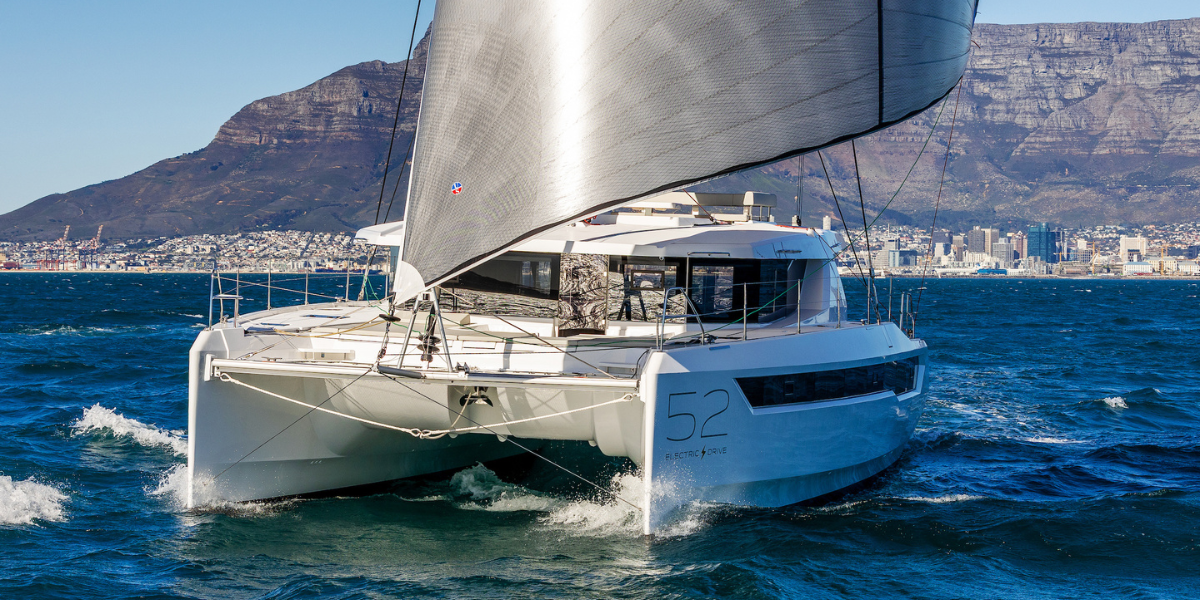
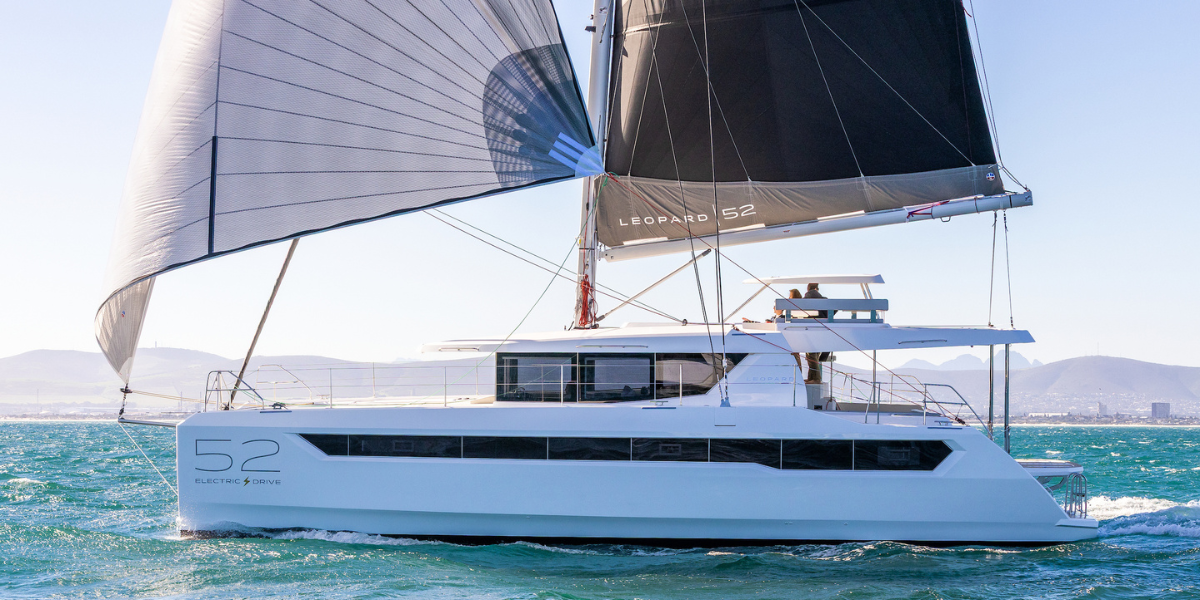
- The Best Bluewater Catamaran for Beginners With Even Bigger Ambitions: The Leopard 52 is the flagship of the sailing range, and while it’s a larger boat, its design philosophy remains consistent: all sail controls lead aft to the helm, twin-seat helm for proper watchkeeping, and factory-integrated solar up to 1,600W. For beginner owners with serious long-range cruising ambitions, or families who want space without compromise, the 52 delivers capability you’ll still be growing into on your tenth passage.
- The Best Entry Point Through the Brokerage Market: If buying new isn’t the right fit for your budget or timeline, the Leopard brokerage market offers exceptional value. A pre-owned Leopard 42 or Leopard 45 gives first-time owners immediate access to the same design principles, at a lower upfront cost and with faster availability. The steepest depreciation has already occurred, making brokerage Leopards one of the smartest entry points into bluewater catamaran ownership for beginners who want to start cruising now rather than wait for a build slot.
Frequently Asked Questions About Bluewater Catamarans for Beginners
What size catamaran is best for a beginner?
For most first-time bluewater catamaran owners, a 42 to 46-foot catamaran strikes the ideal balance between genuine offshore capability and manageable complexity. Boats in this range are large enough to cross oceans and carry the provisions required for extended cruising, yet small enough for a couple to handle confidently without additional crew.
Can a beginner sail a catamaran alone or with just one other person?
Yes, provided the catamaran is specifically designed for shorthanded sailing. The key features to look for are all sail control lines led aft to the helm, electric winches and a protected helm station with clear 360-degree visibility. All Leopard sailing catamarans are engineered around these principles, making them genuinely manageable for a couple or even a single-handed sailor, regardless of experience level.
How much does it cost to own a bluewater catamaran?
Beyond the purchase price, budget approximately 10% of the boat’s value per year for ongoing costs including insurance, maintenance, haul-outs, sail and rigging inspections, and general upkeep. Marina fees vary significantly by region and catamaran size, with catamarans typically requiring larger, more expensive berths than monohulls. Insurance premiums are influenced by vessel value, cruising region, and owner experience, with first-time owners sometimes facing higher premiums until they build an operating history.
Should a beginner buy a new or brokerage bluewater catamaran?
Both are legitimate entry points for beginners. A new build offers the latest design features, manufacturer warranties, and full customization, but comes at a premium and requires waiting for a build slot. A brokerage catamaran offers immediate availability, lower upfront cost, and has already absorbed the steepest depreciation. Pre-owned Leopard 42 or Leopard 45 models, for example, give first-time owners access to proven bluewater capability at a more accessible price point, though a thorough survey is essential to understand any upgrade or refit costs.
How long should a beginner sail coastally before attempting an offshore passage?
A full season of coastal and short-passage sailing is the practical minimum before attempting a serious offshore leg. The goal of that first year isn’t distance, it’s developing intimacy with your boat, its systems, and its handling characteristics in varying conditions. Most experienced sailors recommend completing several overnight passages, multiple anchoring scenarios, and basic systems troubleshooting before planning a multi-day offshore crossing. The right catamaran accelerates this progression by making every aspect of ownership more intuitive from day one.
Choosing the Right Bluewater Catamaran for Your Beginning
The sailing world will always have its opinions about who belongs on a bluewater catamaran and when. But the dock party experts aren’t the ones who get to decide what your first boat looks like, and neither is the conventional wisdom that’s kept too many sailors second-guessing themselves for too long. The right catamaran isn’t a reward for experience you don’t have yet. It’s the platform that helps you build it.
Choose one that was built for what’s coming, and the rest is just learning. And learning, out on the water with the right catamaran beneath you, is the best part of the whole adventure
So where do you go from here? Start by exploring the full Leopard sailing catamaran lineup and comparing models side by side to find the one that fits your ambitions. Dig into real owner experiences on the Leopard Catamarans blog to see what beginner ownership genuinely looks like at sea, alongside independent reviews from trusted voices like Cruising World and Sail Magazine.
And when you’re ready to move from research to reality, connect with a Leopard specialist who can match your goals, experience level, and budget to the right model.