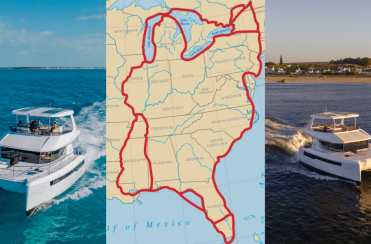
Leopard owners all have different plans and ambitions with their sail or power catamarans. Some take their yachts on extensive travels, others stay closer to shore. The most important part of travelling farther away is being able to get your engines serviced.
All Leopard Catamarans are powered by Yanmar engines. Yanmar is the most commonly used marine diesel engine and service is available in more than 130 countries and territories.
Engine upgrades
On the Leopard 50 and Leopard 58 we offer the option to upgrade to a larger / more HP engine. On the Leopard 50 one can upgrade from 57 HP to 80 HP, and on the Leopard 58 from 80 HP to 110 HP. On the latter, the drive changes from a saildrive to a V drive, as the 110 HP engines are not available as a saildrive. The largest saildrive by Yanmar is 80 HP, and this is basically the same engine as the 57 HP but with a turbo intercooler to get the output to 80 HP.
Larger engines allow your catamaran to reach hull speed at lower revs, so you burn less fuel. However, this comes at a cost, as the price for larger engines is higher as well. Once a catamaran reaches hull speed, it reaches the point of diminishing returns: if you push the engine to higher revs to go faster, the fuel burn goes up exponentially, and the boat speed goes up just a little bit. Your yacht also pushes a much larger wake and you see the stern of your Leopard go down. Leopard sailing catamarans have a displacement hull, not a planing hull — otherwise one could hang 2 x 300 HP outboard engines on the back and go really fast!
Where are the engines and fuel tanks?
On all Leopard sailing catamarans, the engines are located in the aft transoms, separated from the aft cabins by the aft bulkhead. Our engines and saildrives are reverse-mounted, meaning the saildrive sits in front of the engine. This does not change anything in the dynamics of the propulsion; however, the advantage is that there is much more space in the aft cabins. The fuel is held in polyethylene (plastic) fuel tanks underneath the bunks. If ever the need arose to remove the tanks, it would be a relatively easy task. The weight of the engines and tanks is carefully balanced with other equipment on board so that your Leopard will have an even trim.
Differences with the power catamarans
The engines on board the Leopard 43 PC and 51 PC are located underneath the aft beds. Power catamarans are very weight-sensitive, and due to the fact that the engines on the 43 PC have an output of 2 x 320 HP and the 51 PC has 2 x 370 HP, the transmission to the propeller is through a straight shaft. A straight-shaft transmission takes up significantly more space than a saildrive, hence the location further forward. The insulation of the engine bay, the liner and the engine hatch ensures a very dampened noise level while underway. We sometimes have potential Leopard owners question the “engine under bed” feature, but once we take them out on a sea trial they realise the low noise level in relation to all the other benefits of the Leopard power catamarans.
Do I need bow thrusters?
Leopard offers the optional bow thruster only on our flagship, the Leopard 58. On smaller Leopards there is simply no need for it: with engines that are 20 or more feet (around 6 m) apart, and a bit of practice, you can dock a Leopard quite easily. The Leopard 58 is a large yacht with quite a bit of windage, and it can be difficult to push the bow off by hand, hence the bow thruster option.
Are electric engines an option?
The first production catamarans with electric engines were launched 15 years ago, and the fact that no production builder is currently using electric drives is a statement that the available technology is not ready for marine applications. Robertson and Caine / Leopard builds catamarans that are easy to service anywhere in the world, and (as of now) complicated electric drives and recharging systems would not fit this demand. However, Leopard is keen on reducing fossil fuel usage, and solar panels can be fitted on any Leopard catamaran model.
Should I upgrade to AGM batteries?
Lead-acid batteries are the standard type offered on Leopard catamarans, but most Leopard buyers opt for the upgraded AGM batteries. AGM stands for absorbent glass mat. They were originally developed for military aircraft, where power, weight, safety and reliability were paramount considerations. The main advantage of AGM batteries is the fact that they hardly require maintenance, and if properly used and recharged, they can last a long time. As of 2019, Leopard offers lithium batteries as an option on the Leopard 50. Lithium batteries are the next step in battery efficiency. They are lightweight, and they can be discharged much more than lead-acid and AGM batteries. However, this comes at a cost: lithium batteries are expensive.
Will I be able to run my air conditioning off the batteries?
At present, this is not possible on our catamarans. However, Robertson and Caine and Leopard Catamarans are currently designing a system which would allow a Leopard 50 owner with lithium batteries and an additional inverter to run one air-conditioning handler and the chiller system off the lithium batteries. As technology advances, we expect to offer this on other models as well.
At Leopard Catamarans we believe in tried and tested systems. The technology found on Leopard catamarans can be easily serviced and maintained with common knowledge of systems. Leopard owner manuals contain a wealth of information and “how to” sections, and are widely regarded as the best manuals among production catamaran builders. If your owner manual does not answer your questions, Leopard has an experienced and qualified technical department on stand-by to support you with anything you might need as a Leopard catamaran owner.